
Executive Summary: Indonesia’s 2026 Upstream Push and the Complexity of Multi-Zone Offshore Production
Indonesia’s upstream oil and gas sector is executing one of its most ambitious programs in over a decade. SKK Migas has launched its “Triple 100” initiative for 2026, targeting 100 exploration wells and 100 multi-stage fracturing wells in a single year — an ambitious signal of the sector’s recovery trajectory [1]. Eight upstream oil and gas projects were scheduled to come onstream in 2026 with a combined capital expenditure of USD 478 million, expected to add approximately 8,200 barrels of oil per day and 214 million standard cubic feet per day of gas to Indonesia’s national production balance [2]. Among the most significant of these, the South Senoro Phase II condensate project operated by JOB Pertamina-Medco Tomori Sulawesi commenced operations targeting 110 million standard cubic feet per day of gas and 2,800 barrels of condensate per day from Q1 2026 [2], while the Sedingin North-1 field production facility operated by PT Pertamina Hulu Rokan is targeting full-scale operations by Q4 2026 [3].
Looking further ahead, the Abadi LNG project in the Arafura Sea — Indonesia’s single largest undeveloped gas resource at 18.54 trillion cubic feet — is advancing toward a final investment decision targeted for 2026 or early 2027 [4], and Kufpec has secured development approval for the Anambas working area in the Natuna Sea [4], a region characterized by high CO₂ reservoir gas that creates extraordinarily demanding completion engineering requirements.
What all of these programs share — from the relatively straightforward Sedingin North-1 oil facility to the complex CO₂-rich Natuna Sea development — is the multi-zone completion challenge: Indonesia’s offshore reservoirs frequently contain multiple stacked producing intervals at different depths, each with distinct pressure regimes, fluid compositions, and production rates. Producing these intervals selectively, maintaining their isolation from one another, and sustaining production across the full field life without excessive intervention requires completion equipment that is both precisely engineered for the specific reservoir sequence and corrosion-resistant enough to survive decades of exposure to Indonesia’s aggressive offshore fluid environments.
Parveen Industries manufactures the full suite of downhole completion equipment — production packers, bridge plugs, cement retainers, and wireline tools — required for Indonesia’s multi-zone offshore completions.
The Engineering Complexity of Indonesian Multi-Zone Offshore Completions
Stacked Pay Intervals: Indonesia’s offshore basins — the Java Sea, Makassar Strait, Natuna Sea, and East Kalimantan deepwater — commonly contain multiple productive sandstone and carbonate intervals stacked vertically within the same wellbore. A well completed through five or six separate pay zones requires a completion architecture that isolates each zone from the others while allowing selective production from each. This demands:
- One packer per interval boundary (between productive zones and between productive and non-productive intervals)
- Correctly sized and positioned production tubing strings or sliding sleeve valves to allow selective commingling or isolation of individual zones during production
- Bridge plugs or cement retainers for zones that are to be abandoned or temporarily isolated during early production
High CO₂ Reservoir Environments: The Natuna Sea and portions of the Makassar Strait are characterized by gas reservoirs with CO₂ content ranging from 15% to over 70% by volume. At these concentrations, dissolved CO₂ in produced water creates carbonic acid at concentrations that corrode carbon steel completion components aggressively. Production packers with carbon steel mandrel materials and standard nitrile element compounds will experience accelerated degradation in these wells; bridge plugs set in CO₂-rich formations for permanent isolation must be manufactured from materials that will not corrode through over the well’s productive life. Corrosion-resistant alloy (CRA) materials — 13Cr stainless steel and above — are the engineering response to this challenge.
Variable Reservoir Pressures Across Zones: In a multi-zone completion, each producing interval may have a significantly different reservoir pressure. If these intervals are not properly isolated from each other, the higher-pressure zone will cross-flow into the lower-pressure zone within the wellbore, reducing production efficiency from both zones and potentially causing well control complications. The production packer system must maintain differential pressure integrity across these zone-to-zone pressure differentials for the entire productive life of the well — in some Indonesian fields, 20 years or more.
Offshore Logistics Constraints: Indonesia’s offshore wells — particularly those on unmanned platforms in the Java Sea or in semi-remote locations in East Kalimantan — face logistics constraints that make well intervention significantly more expensive than in onshore environments. A workover on an Indonesian offshore well typically requires mobilization of a jackup rig or workover vessel, a full crew, consumables, and security-cleared transport, representing minimum mobilization costs of USD 500,000–2,000,000 before a single hour of downhole work is performed. This economic reality places a premium on completion equipment that performs reliably for long periods without requiring intervention.
Parveen Industries: Multi-Zone Completion Equipment for Indonesian Offshore Fields
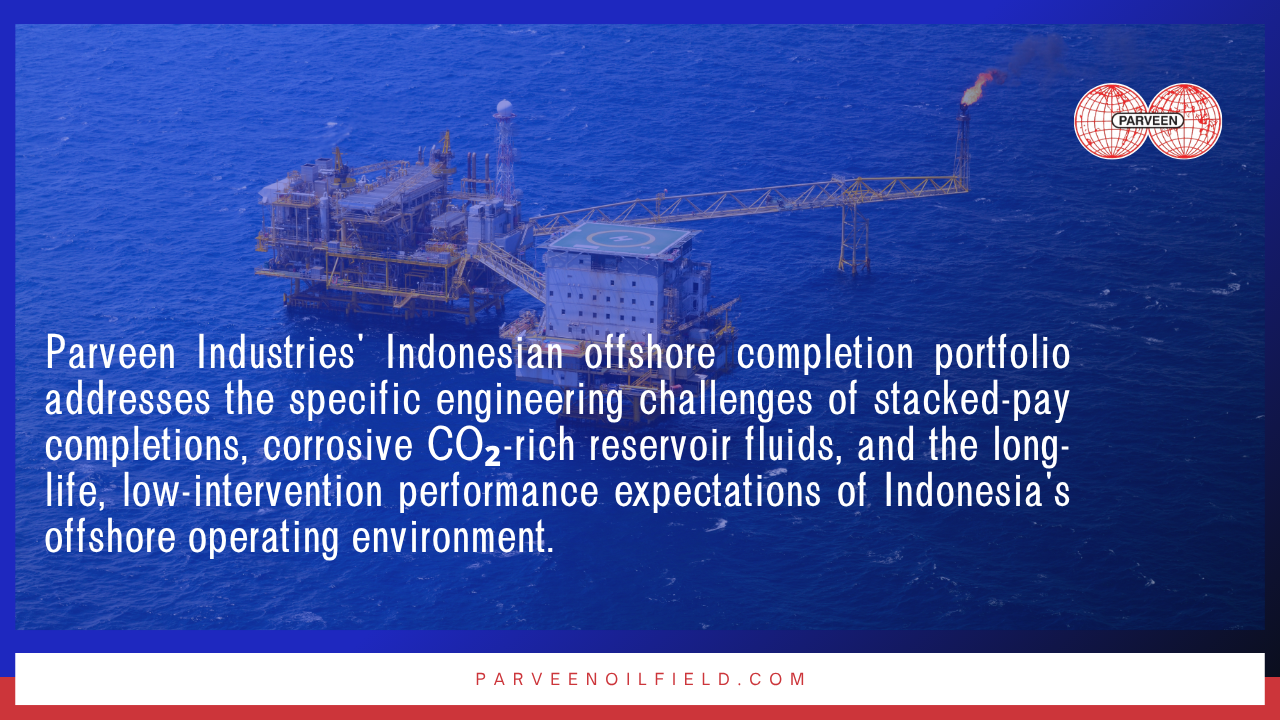
Parveen Industries’ Indonesian offshore completion portfolio addresses the specific engineering challenges of stacked-pay completions, corrosive CO₂-rich reservoir fluids, and the long-life, low-intervention performance expectations of Indonesia’s offshore operating environment.
Production Packers — CRA and HNBR for Corrosive Indonesian Service Parveen’s production packer product range for Indonesian offshore service spans both hydraulic-set retrievable designs (for workovers, temporary zone isolation, and re-completions) and permanent hydraulic-set packers (for definitive long-life zonal isolation in multi-zone completions). Key specifications for Indonesian CO₂-rich service include:
- Mandrel and slip components in 13Cr stainless steel for high-CO₂ environments, eliminating the primary CO₂ corrosion pathway
- Packer element compounds in HNBR (for moderate CO₂/H₂S service) or AFLAS (for high-CO₂, elevated temperature service above 150°C)
- High-strength slip systems rated for the differential pressures between stacked pay zones in multi-zone well architectures
- Parveen’s RHP-SPR and RHP-DB retrievable packer designs specifically provide long-term seal integrity under the variable differential pressure profiles encountered in Indonesian multi-zone producing wells
Bridge Plugs — Wireline-Set Drillable for Zone Abandonment and Isolation In multi-zone completions where one or more intervals are to be temporarily isolated during initial production — for production test purposes, for deferred zone development, or for zone abandonment — Parveen’s wireline-set drillable bridge plugs provide reliable isolation without requiring a workover rig for setting. Available in composite and cast-iron drillable designs, with setting tool compatibility for wireline and pump-down systems. Both the Parveen Model A Premium and Model BKR series are available for Indonesian operator requirements.
Cement Retainers — Remedial Cementing for Zone Isolation Where primary cementing of a multi-zone well has left voids or channels behind casing, or where zonal isolation has degraded due to microannulus formation over the well’s life, remedial squeeze cementing through a cement retainer restores the isolation barrier without a full well recompletion. Parveen’s wireline-set drillable cement retainers — BKR Premium and BKR Lite series — provide reliable downhole retention of cement during squeeze operations at the differential pressures encountered in Indonesian reservoir sequences.
Wireline Setting Tools — Fury Series Hydraulic Setting Tools Precise placement of packers and bridge plugs in multi-zone wells requires setting tools that deliver consistent hydraulic energy to the tool’s setting mechanism regardless of wellbore conditions. Parveen’s Fury series hydraulic setting tools — available in Fury 05, Fury 10, and Fury 20 configurations for different well size and depth requirements — provide this reliability in Indonesian offshore well conditions, including deviated and extended-reach well profiles common in the Java Sea platform well programs.
Flow Control Equipment — Selective Zone Management For multi-zone wells where production from individual intervals is to be managed dynamically across the producing life of the field, Parveen’s sliding sleeves and landing nipples allow selective zone opening, closing, and flow rate adjustment via wireline, without workover rig intervention. This capability is particularly valuable in Indonesian multi-pay completions where the relative production contributions of individual zones evolve as reservoir pressure depletes at different rates across the pay sequence.
Gas Lift Equipment — Sustaining Offshore Production from Declining Reservoirs Mature offshore fields in the Java Sea and East Kalimantan face the universal challenge of declining reservoir pressure. Gas lift remains the primary artificial lift method across many Indonesian offshore platforms, and the reliability of gas lift valves and mandrels directly determines whether a platform well produces at its capability or falls below economic rate. Parveen’s pilot-operated gas lift valves and wireline-retrievable gas lift valves — in CRA-compatible materials for CO₂-prone environments — provide the production optimization capability that Indonesian offshore operators need for mature field life extension.
Downhole Completion Systems — Integrated Multi-Zone Architecture Parveen’s complete multi-zone completion system integrates packers, landing nipples, sliding sleeves, gas lift mandrels, and setting tools into a coherent, dimensionally compatible downhole architecture. Supply of the complete system from a single manufacturer eliminates the compatibility risk inherent in assembling a multi-zone completion from components sourced from multiple suppliers with different flange interfaces, drift diameters, and thread forms.
 Equipment Relevance: Case Illustration — Five-Zone Completion, Java Sea Offshore Platform
Scenario: An operator on a Java Sea platform has a new development well penetrating five productive sandstone intervals across a 600-metre gross interval. Reservoir analysis indicates that zones 2 and 4 have significantly higher initial reservoir pressure than zones 1, 3, and 5, creating a cross-flow risk if they are commingled without isolation. CO₂ content in the gas cap is approximately 12%, creating a moderate sweet corrosion environment. The operator plans to produce zones 1, 3, and 5 initially, with zones 2 and 4 isolated by bridge plugs pending a reservoir management decision on commingling versus separate tubing string production.
Equipment Requirements: Four production packers to isolate zone boundaries; two wireline-set drillable bridge plugs for zones 2 and 4; landing nipple profiles for future wireline access to each zone; sliding sleeves for zones 1, 3, and 5 to allow individual zone management; 13Cr packer mandrel components for CO₂ corrosion resistance; HNBR packer elements for moderate CO₂ service.
Parveen’s Solution: Complete multi-zone completion package supplied as an integrated system with full dimensional compatibility across all components. 13Cr mandrel materials and HNBR element compounds applied throughout the packer string for CO₂ corrosion resistance. Wireline-set bridge plugs for zones 2 and 4, with drillable design confirmed for eventual mill-out when the operator decides to bring those zones into production. Full API 11D1 documentation, material test reports, and setting tool operational procedures supplied for the operator’s well engineering files and SKK Migas regulatory submission.
Frequently Asked Questions (FAQs)
Q1. What CRA material options does Parveen offer for production packers in Indonesia’s CO₂-rich offshore wells? For Indonesian wells with CO₂ content requiring CRA packer mandrel materials, Parveen offers 13Cr stainless steel as the standard CRA grade — appropriate for CO₂ partial pressures below approximately 0.5 MPa and temperatures below 150°C — and Super 13Cr for higher CO₂ partial pressures or elevated temperatures. For the most severe environments (very high CO₂ with trace H₂S and high chloride), 22Cr duplex stainless steel is available. CRA material selection is made by Parveen’s completion engineering team based on the operator’s well fluid analysis and downhole conditions, ensuring that the specified material adequately addresses the actual corrosion risk.
Q2. Are Parveen’s wireline-set bridge plugs compatible with the setting tool systems used by Indonesian wireline service companies? Yes. Parveen’s bridge plug and bridge plug setting tool designs are compatible with the standard wireline tool string configurations used by major wireline service providers operating in Indonesia. Parveen’s Fury series hydraulic setting tools are available as standalone setting tool heads that attach to the operator’s wireline tool string using standard crossover connections. For pump-down bridge plug applications in horizontal or highly deviated Indonesian wells, pump-down setting tool configurations are available.
Q3. Can Parveen supply a complete multi-zone completion system with dimensionally integrated components from a single manufacturer? Yes. This is one of Parveen’s core capabilities for Indonesian multi-zone completions. A Parveen multi-zone system encompasses production packers, landing nipples, sliding sleeves, gas lift mandrels, and wireline setting tools — all designed by Parveen’s engineers with consistent bore sizes, drift diameters, and thread connections across the full system. This eliminates the risk of downhole interference between components from different manufacturers, simplifies the running and setting procedure for the completion crew, and provides a single documentation package covering the entire downhole completion for the operator’s SKK Migas submission files.
Q4. What are the lead times for multi-zone completion packages for Indonesian offshore wells? A complete multi-zone completion package — covering multiple packers, bridge plugs, landing nipples, and setting tools — typically carries a 12–16 week manufacturing lead time from confirmed purchase order. For offshore well programs where the completion schedule is tightly coupled to rig availability and platform installation, Parveen recommends initiating equipment procurement at least 18–20 weeks before the planned completion date to provide manufacturing and logistics buffer. Parveen can also pre-stock standardized components for Indonesian operators with recurring completion programs to reduce per-well lead times.
Q5. How does Parveen ensure its completion equipment meets SKK Migas regulatory and documentation requirements for Indonesian offshore wells? Parveen’s quality management system generates a comprehensive documentation package for all completion equipment orders, including material test reports traceable to original heat numbers, dimensional inspection records for all critical components, hydrostatic test certificates, and API specification compliance records (API 11D1 for packers, API 11V1 for gas lift, API 14A for safety valves). This documentation package is structured to meet the typical regulatory file requirements for Indonesian offshore wells under SKK Migas oversight. Parveen can also provide documentation in digital format for integration with the operator’s electronic well filing system.
Q6. Can Parveen supply downhole completion equipment for Indonesian wells operated under Production Sharing Contracts by companies like Pertamina, Medco, and international operators? Yes. Parveen’s product range and quality documentation system is compatible with the vendor qualification requirements of Indonesian PSC operators including Pertamina Hulu Energi, Medco E&P, and international operators active in Indonesian production-sharing contract areas. Parveen’s API monogram certification and ISO 9001 quality management system provide the foundational credentials for vendor qualification with all of these operators. For specific vendor qualification requirements, Parveen works directly with the operator’s procurement team to complete the required submissions.
Call to Action
Indonesia’s offshore multi-zone reservoirs hold substantial production potential — but realizing that potential over the full field life requires completion equipment that maintains zonal isolation, resists corrosion, and operates reliably across decades without unnecessary intervention.
Consult with Parveen Industries today to design your multi-zone offshore completion system — from CRA production packers and wireline-set bridge plugs to integrated flow control and gas lift equipment.
📧 Visit parveenoilfield.com/id/ to submit your technical requirements, download product datasheets, or connect with Parveen’s Southeast Asia application engineering team.
Parveen Industries — API-Compliant. Corrosion-Resistant. Multi-Zone Ready.
Data Sources & References
[1] SKK Migas’s “Triple 100” initiative — targeting 100 exploration wells and 100 multi-stage fracturing wells in 2026 — was announced by SKK Migas Head Djoko Siswanto in Jakarta in February 2026, reported by ANTARA News (https://en.antaranews.com/news/404030/indonesias-skk-migas-to-drill-100-exploration-wells-in-2026).
[2] The eight upstream oil and gas projects targeted to come onstream in 2026 with combined capex of USD 478 million, adding approximately 8,200 BOPD and 214 MMSCFD of gas, including the South Senoro Phase II project’s target of 110 MMSCFD gas and 2,800 BCPD condensate from Q1 2026, are reported by Indonesia Business Post (https://indonesiabusinesspost.com/6069/energy-and-resources/skk-migas-targets-eight-upstream-oil-and-gas-projects-to-go-onstream-in-2026).
[3] The Sedingin North-1 field production facility targeting full-scale operations by Q4 2026, adding 325 BOPD, is reported by Energies Media (https://energiesmedia.com/skk-migas-indonesia-oil-and-gas-projects/), citing SKK Migas project data published February 2026.
[4] The Abadi LNG project FEED targeting completion in 2025 with FID planned for 2026 (or by 2027 as INPEX’s target), holding 18.54 TCF of gas reserves, and the Kufpec development approval for the Anambas working area in the Natuna Sea, are both reported by Indonesia Business Post (https://indonesiabusinesspost.com/5101/energy-and-resources/abadi-lng-pushed-toward-final-investment-decision-as-feed-nears-completion), citing SKK Migas and INPEX statements from August 2025.