
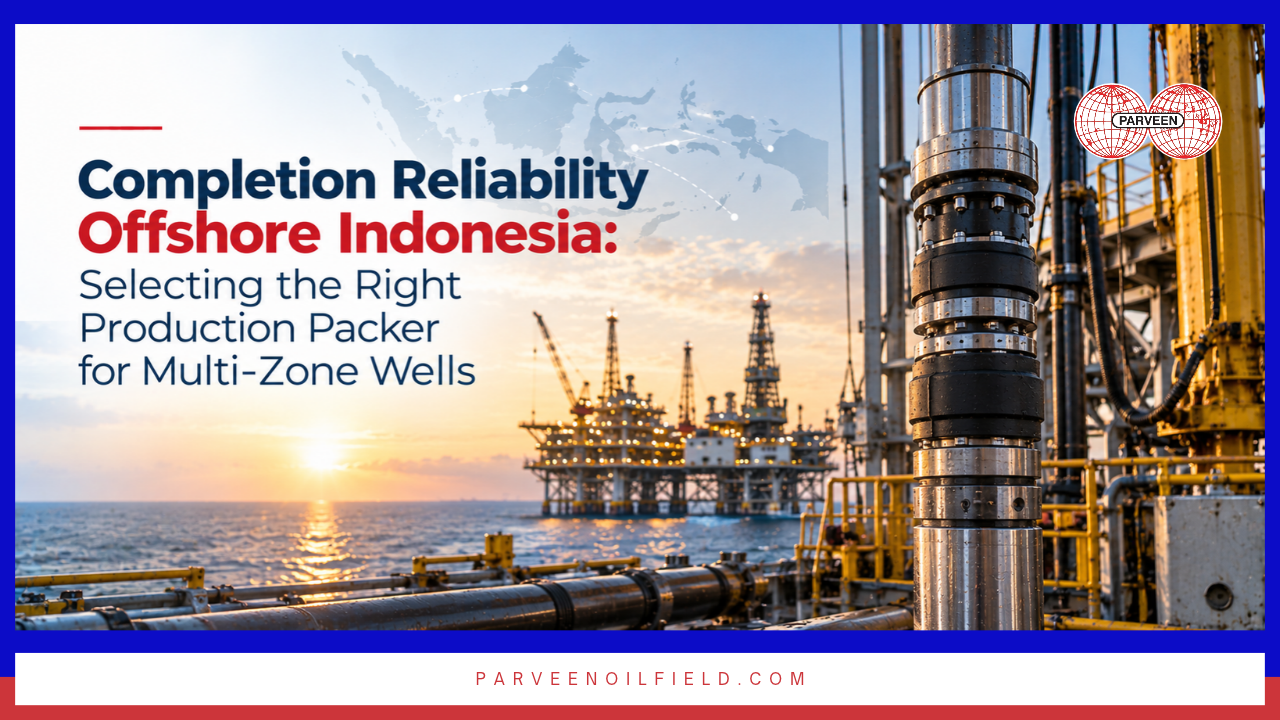
Indonesia’s upstream oil and gas sector is navigating a complex transition, managing production from an ageing field portfolio while simultaneously developing new frontier resources offshore. SKK Migas (the Indonesian Upstream Oil and Gas Regulatory Special Task Force) reported total oil and gas lifting of approximately 1.0 million barrels of oil equivalent per day (boe/d) in 2024, with natural gas contributing an increasingly dominant share driven by production from the Tangguh LNG facility (BP, Mitsubishi, Japan LNG Indonesia), the South Mahakam complex (TotalEnergies), Muara Bakau (ENI), and the offshore Madura and Natuna blocks [1]. The government’s upstream investment target for 2026 and beyond focuses on accelerating development of discovered but undeveloped reserves, many of which are in offshore multi-layer geological settings that require carefully designed multi-zone completions.
Multi-zone completions are those in which a single wellbore penetrates and produces from two or more distinct reservoir intervals, each isolated from the others by production packers in the wellbore annulus. This architecture allows a single well, with its associated development costs and offshore platform slot, to simultaneously produce from multiple pay zones, dramatically improving the economic return on each well in Indonesia’s high-cost offshore environment [2]. Without reliable zonal isolation, commingled production from different reservoir intervals introduces problems including cross-flow between zones (one zone re-injecting into another), inability to manage individual zone depletion rates, and difficulty diagnosing production decline when it occurs.
The production packer is the downhole completion component that creates and maintains zonal isolation. Set in the annulus between the production tubing and the casing or production liner, the packer seals off the annular space to isolate different reservoir intervals from each other and from the surface wellbore tubular string. The packer’s setting mechanism (hydraulic, mechanical, or permanent), its elastomeric seal element specification, its pressure and temperature rating, and its retrievability, or permanent nature, determine whether it will provide reliable isolation for the intended production life of the well, which in Indonesia’s offshore environment may extend 15–25 years.
Parveen Industries manufactures a complete range of API-compliant production packers and completion equipment for the upstream oil and gas market, including Indonesia’s offshore multi-zone completion applications. This article examines the key engineering considerations for production packer selection in Indonesia’s offshore environment and introduces Parveen’s downhole completion product portfolio for Indonesian operators, completion contractors, EPCs, and procurement teams.
Indonesia’s offshore completion equipment procurement market is influenced by SKK Migas approval requirements, TKDN (Tingkat Komponen Dalam Negeri, domestic content) obligations under TKDN regulations, and the technical requirements imposed by operators with strict global completion design standards. Understanding how these regulatory requirements intersect with the engineering considerations for production packer selection is essential for procurement teams navigating Indonesian upstream equipment supply.
Understanding Production Packers for Multi-Zone Wells
The Role of the Production Packer
A production packer is a downhole mechanical device that is deployed on the production tubing string during the completion phase of a well. Once at the target depth, the packer is set, either by hydraulic pressure applied through the tubing, by mechanical manipulation of the tubing string, or, in the case of permanent packers, by a retrievable running tool, to expand its sealing elements radially outward against the casing or liner ID. Once set, the packer maintains a pressure-rated seal in the annulus that prevents fluid communication between zones above and below the packer element.
For a two-zone well, a single packer is required to isolate the lower zone from the upper. For a three-zone well, two packers are required, one above the lower zone and one above the middle zone. The number of packers increases with the number of zones, and the mechanical complexity of the completion increases accordingly. In Indonesia’s offshore Mahakam block, TotalEnergies has operated wells with up to four producing zones stacked in a single wellbore, each isolated by a dedicated production packer [3].
Setting Mechanism Selection for Indonesian Offshore Wells
Hydraulic-Set Retrievable Packers: Hydraulic-set retrievable packers are activated by applying a specified hydraulic pressure to the tubing string at the surface, compressing the packer element radially against the casing. They can be retrieved by releasing hydraulic pressure, applying a right-hand rotation and upward pull on the tubing string to unseat the slips and release the element. This setting mechanism is preferred for multi-zone completions where individual zones may need to be accessed independently through future workover operations, for example, to selectively stimulate a lower zone without disturbing the completion in the upper zone.
In Indonesia’s offshore environment, hydraulic-set retrievable packers offer a key operational advantage: the setting operation is confirmed at surface by pressure and weight-on-string indicators, without requiring the wellbore fluid circulation that mechanical setting methods need. This simplifies the completion procedure on semi-submersible rigs where rig time is expensive and completion operations are on critical path.
Parveen’s RHP-DB Dual Bore Hydraulic Set Retrievable Packer is engineered for multi-zone completions requiring hydraulic setting and future retrievability. The dual bore design allows simultaneous flow from two tubing strings, a critical feature for dual-string completions used in some Indonesian offshore fields where the annulus gas lift tubing and production tubing are run simultaneously.
Mechanical Set Retrievable Packers: Mechanically set packers are activated by a combination of weight, rotation, and pick-up applied to the tubing string at surface, no hydraulic pressure is required. This mechanism is preferred in situations where the wellbore fluid or wellbore geometry does not allow reliable hydraulic setting, for example, in highly deviated wells where hydraulic pressure equalisation along the wellbore is uncertain, or in wells with fluid loss to the formation that would bleed off the hydraulic setting pressure before the packer reaches its set load.
The Model TST-1 Mechanical Set Packer from Parveen provides a robust mechanically-set solution for Indonesian offshore and onshore applications where a retrievable option is needed without the hydraulic setting circuit.
Permanent Packers: Permanent packers are designed for long-term zonal isolation without retrievability, once set, they remain in the wellbore for the production life of the well and are milled out if removal becomes necessary. Permanent packers generally provide a more reliable seal integrity over long production periods than retrievable packers, as the setting load is not dependent on maintaining mechanical engagement over time. They are specified for Indonesian offshore completions where the reservoir isolation requirement is long-term (15+ years), the cost of a workover to retrieve the packer is high, and the zonal configuration is unlikely to change.
Parveen’s Model D & F Permanent Packers are API 11D1 compliant permanent packer options that provide long-term annular isolation for Indonesian offshore production wells.
Engineering Considerations for Packer Selection in Indonesia’s Offshore Environment
Pressure and Temperature Rating
The packer’s pressure rating (differential pressure across the element) and temperature rating must encompass the entire expected range of operating conditions throughout the well’s production life, not just initial conditions. In Indonesia’s offshore fields, reservoir pressures at target completion depths of 3,000–10,000 feet subsea TVD range from 1,500 to 5,000 psi, with temperatures at depth typically between 160°F and 280°F depending on the geothermal gradient and depth.
API 11D1 (Packers and Bridge Plugs) defines a validation testing matrix for packers, Validation Grades V0 through V6, that specifies the pressure, temperature, and cycle loading conditions under which a packer design has been tested [4]. For Indonesian offshore applications, a minimum of API 11D1 V3 validation is typically required for production packers, confirming performance at the expected differential pressure and temperature conditions for the well’s production life.
Parveen specifies packer designs that have been validated to the required API 11D1 grade for each application, with elastomeric element selection based on the downhole temperature and fluid service: NBR elements for sweet gas and oil at temperatures below 212°F; HNBR for moderate sour service or temperatures up to 302°F; FKM/AFLAS for high-temperature or high-CO₂/H₂S service above 302°F.
Elastomeric Element Specification
The packer’s sealing element is the elastomeric component that expands against the casing ID to create the zonal isolation seal. Element performance is governed by: (i) the chemical compatibility of the elastomer with the wellbore fluid (crude oil, gas, formation water, with specific CO₂ and H₂S content); (ii) the temperature range, elastomers lose elasticity and sealing force at temperatures below their operational minimum and degrade chemically above their maximum operating temperature; and (iii) the differential pressure rating, element extrusion into the casing/tubing annular gap is the primary failure mode at high differential pressure, and element backup rings are used to prevent extrusion at higher differential pressures.
For Indonesian offshore wells producing from the Mahakam gas condensate fields, where CO₂ content in the produced gas can reach 5–10% molar, HNBR or FKM element material is recommended to resist CO₂-induced swelling that can cause NBR elements to lose sealing force over time. Parveen specifies element material for every completion packer order based on the client-provided fluid composition, temperature, and pressure data.
Wellbore Deviation and Completion Architecture
Indonesia’s offshore wells are predominantly directional or horizontal, drilled from platform clusters or subsea wellhead manifolds to reach reservoir targets that may be several kilometres from the surface location. In deviated wells, production packers must maintain their set load and seal integrity under the side load imposed by the wellbore’s angle of deviation, and the completion must be designed to ensure each packer can be run to its target depth without excessive drag.
In highly deviated wells (>60° inclination), hydraulic-set packers are generally preferred over mechanically set packers because the setting mechanism is not sensitive to the tubing weight and friction conditions that complicate mechanical setting in deviated wellbores. The dual-bore hydraulic design of Parveen’s RHP-DB packer is particularly well suited to Indonesia’s deviated offshore wells.
Intervention Flexibility
A key consideration for multi-zone completions in Indonesia, where the economics of an offshore workover can exceed USD 10–20 million per well intervention, is the design for future selective zone access. A completion designed with retrievable packers allows selective re-perforation, zone stimulation, or zone isolation to be performed during a future workover without milling out permanent packers, which preserves wellbore geometry and reduces workover scope and cost.
However, retrievable packer reliability over a 15–20 year production horizon is an inherent technical risk, the retrievability mechanism must remain functional throughout the well’s life. For zones that are expected to produce for the full field life without intervention, permanent packers offer superior long-term isolation assurance at the cost of future flexibility. The completion design for each Indonesian offshore well should optimise the choice between permanent and retrievable packers on a zone-by-zone basis, balancing isolation reliability against intervention flexibility.
Parveen Industries’ Production Packer and Completion Portfolio for Indonesia
Parveen Industries’ completion equipment range for Indonesia’s offshore multi-zone well applications includes:
RHP-DB Dual Bore Hydraulic Set Retrievable Packer: Hydraulic-set, wireline-retrievable packer with dual bore design for simultaneous dual-string completions. Suited for multi-zone completions in deviated Indonesian offshore wells. Available in casing sizes from 4-1/2″ to 9-5/8″. Pressure rating: 5,000 psi differential. Temperature rating to 302°F. Elastomeric elements in NBR, HNBR, or FKM depending on service conditions. API 11D1 validated.
Model TST-1 Mechanical Set Packer: J-slot mechanical set, straight pull retrievable packer for applications where hydraulic setting is not preferred. Suitable for vertical and low-deviation wells in Indonesia. Available in standard tubing and casing sizes. Pressure differential rating per API 11D1 V3 testing.
Model D & F Permanent Packers: Mill-out permanent packers for long-term zonal isolation in Indonesian offshore production wells. Designed for 15–25 year service life. Available in casing sizes from 4-1/2″ to 9-5/8″. Pressure differential rating to 5,000 psi. Set by wireline-conveyed or tubing-conveyed setting tool.
Drillable Bridge Plugs (Wireline Set): Composite or cast-iron drillable bridge plugs for zone isolation, temporary plugback, and selective stimulation isolation in Indonesian offshore completions. Set by wireline-deployed setting tool. Drillable with PDC mill in under 30 minutes for fast zone access during multi-stage stimulation programs.
Cement Retainers (Wireline Set): Wireline-deployed cement retainers for squeeze cementing operations, isolating thief zones, repairing casing leaks, and cementing off depleted zones in Indonesian offshore workover programs.
Subsurface Safety Valve (SSSV): API 14A compliant tubing-retrievable and wireline-retrievable SSSVs for Indonesian offshore production wells, providing the primary downhole safety barrier required by SKK Migas for all offshore producing wells.
Tubing Retrievable Safety Valve (TRSV): API 14A compliant tubing retrievable safety valve providing deep-set emergency wellbore closure for offshore Indonesian wells with high surface pressure.
Gas Lift Equipment: Gas lift valves, side pocket mandrels, and conventional mandrels for artificial lift in Indonesian offshore multi-zone completions where reservoir pressure support is insufficient for natural flow.
Wellhead & Christmas Tree Assemblies: Complete API 6A compliant wellhead and Christmas tree packages for Indonesian offshore development wells, integrating with the downhole completion assembly at the mudline or surface wellhead.
Case Illustration: Three-Zone Hydraulic-Set Completion, Mahakam Block Offshore East Kalimantan
Consider a TotalEnergies-operated development well in the South Mahakam block, targeting three stacked gas condensate reservoir intervals (Senipah Formation) at depths of 5,200, 5,800, and 6,400 feet TVD, through a 5-1/2″ production liner in an 8-1/2″ wellbore. Well inclination is 55° from vertical at packer setting depth. Formation temperature at 6,400 feet is 260°F; reservoir pressure is 2,800 psi; produced gas contains 8% CO₂ molar.
The completion design calls for three-zone hydraulic-set retrievable packers, sized for the 5-1/2″ production liner ID, with HNBR element material (compatible with 260°F temperature and 8% CO₂), and rated for 3,000 psi differential pressure (with margin above the 2,800 psi reservoir pressure). Each packer is set in a landing nipple profile at 5,100, 5,700, and 6,300 feet, isolating the three producing intervals.
Two Parveen RHP-DB Dual Bore Hydraulic Set Retrievable Packers (upper and middle positions) are run on a 3-1/2″ EUE production tubing string and set hydraulically by applying 2,500 psi tubing pressure at surface, confirmed by a 5,000-lbf compressive set weight reading at the surface. A Parveen Model D Permanent Packer is installed at the lowest position (6,300 feet) to provide permanent isolation below the lowest producing zone, eliminating the need for future milling operations at the deepest and least accessible position in the well.
An API 14A compliant SSSV is set at 300 feet subsea, providing the primary downhole safety barrier. The wellhead is completed with a Parveen API 6A wellhead assembly conforming to SKK Migas equipment approval requirements for offshore Kalimantan operations.
After completion, the three zones are produced commingled through the 3-1/2″ production tubing, with individual zone contributions monitored by production logging. After 18 months of production, declining rates from Zone 1 (shallowest) prompt a selective workover, the upper retrievable packer is recovered and Zone 1 is re-perforated in a new interval, after which the packer is re-run and reset. The lower zones are unaffected. This selective workover capability, made possible by the retrievable packer design, avoids the cost of a full workover on all three zones and extends the economic production life of the well by an estimated 4 years.
Frequently Asked Questions
Q1: What API standard governs production packers for Indonesian offshore wells, and what does it mean for equipment selection?
Production packers are governed by API Specification 11D1 (Packers and Bridge Plugs), which defines dimensional requirements, material requirements, and validation testing for all packer types. API 11D1 defines a series of Validation Grades (V0 through V6) based on the pressure and temperature test envelope. For Indonesian offshore wells, Validation Grade V3 (moderate pressure differential, moderate temperature) is the minimum typically required; high-pressure, high-temperature applications may require V4 or V5 validation. Procurement teams should request confirmation of the API 11D1 validation grade when sourcing packers, as validation testing confirms that the specific packer design, not just the material, has been tested to perform at the specified pressure and temperature conditions.
Q2: How does Parveen determine the correct elastomer specification for a production packer in an Indonesian offshore well?
Parveen selects the packer element elastomer based on four parameters provided by the client: (1) downhole temperature at packer setting depth; (2) produced fluid composition, specifically H₂S partial pressure, CO₂ content, and hydrocarbon type (oil/condensate/gas); (3) expected production life; and (4) differential pressure across the element. For most Indonesian offshore gas condensate wells (low H₂S, 5–15% CO₂, 200–280°F), HNBR (Hydrogenated Nitrile Butadiene Rubber) is the standard recommendation, providing superior resistance to CO₂-induced degradation compared to standard NBR and operating reliably up to 302°F. For higher-temperature or higher-sour applications, FKM (Viton) is specified. Parveen provides element specification documentation for each order, confirming the basis for elastomer selection.
Q3: Does Parveen’s completion equipment meet SKK Migas requirements and TKDN obligations for Indonesian upstream operations?
Parveen’s production packers, SSSVs, and completion equipment are manufactured to API standards (API 11D1, API 14A, API 6A as applicable) that are recognised by SKK Migas for upstream equipment approval in Indonesia. For TKDN compliance, Parveen can work with the Indonesian operator or completion contractor to provide the necessary documentation of local content components and supply chain elements. While Parveen is an Indian manufacturer, its products are imported and distributed through local Indonesian trading and oilfield supply channels, and the local procurement, warehousing, and service support elements contribute to the TKDN calculation. Indonesian buyers are encouraged to contact Parveen’s distribution partners in Indonesia for TKDN documentation specific to their project.
Q4: Can Parveen supply production packers in non-standard casing sizes or high-deviation wellbore configurations common in Indonesian offshore wells?
Yes. Parveen manufactures production packers in standard API tubing and casing sizes from 4-1/2″ to 9-5/8″ and in connection types compatible with the major tubing and casing suppliers. For non-standard liner sizes (such as 5-1/2″ or 6-5/8″ production liners used in some Indonesian offshore completions), Parveen can manufacture to client-specified dimensions from approved engineering drawings. For high-deviation applications (>55° inclination), Parveen’s engineering team reviews the specific well deviation profile and confirms that the selected packer design’s set-load mechanism is compatible with the expected side-load and friction conditions.
Q5: What is the expected service life of a hydraulic-set retrievable packer in Indonesia’s offshore environment, and what causes premature failure?
A well-specified and correctly installed hydraulic-set retrievable packer should maintain its zonal isolation seal for the intended production life of the well, typically 10–20 years for Indonesian offshore completions. The most common causes of premature packer seal failure are: (1) incorrect elastomer specification (NBR elements degrading in CO₂-rich gas service above 212°F); (2) insufficient set load, not achieving the specified hydraulic setting pressure during installation, resulting in a low initial seal compression; (3) thermal cycling, differential expansion and contraction of the tubing string relative to the casing, which can gradually reduce the element contact force over multiple temperature cycles; and (4) sand or scale production that abrades or bridges the element. Parveen’s application engineering process is designed to select the correct specification at the outset, eliminating the most common pre-failure specification errors.
Q6: Can Parveen supply a complete multi-zone completion package, packers, SSSVs, bridge plugs, cement retainers, and wellhead, for an Indonesian offshore development well?
Yes. Parveen can supply a complete downhole completion package for multi-zone Indonesian offshore development wells, integrating production packers, API 14A compliant SSSVs, wireline-set bridge plugs, cement retainers, and API 6A compliant wellhead and Christmas tree assemblies. Sourcing the complete completion package from a single API-compliant manufacturer simplifies interface management, consolidates quality documentation into a single package, and reduces procurement administration. Parveen’s commercial team can provide a complete package quotation for Indonesian operators and EPCs based on well design data, bore size, casing and liner programme, reservoir pressure and temperature, fluid composition, and number of production zones.
Sourcing Completion Equipment for Indonesian Offshore Wells
Indonesian upstream operators, completion contractors, EPCs, and procurement teams sourcing production packers and complete multi-zone completion equipment packages for offshore Indonesia are invited to contact Parveen Industries. Parveen’s engineering team can review well design data and provide tailored product recommendations, technical data sheets, API validation documentation, and commercial quotations.
📧 Contact Parveen Industries, Indonesia Website: parveenoilfield.com/id/ Email: info@parveen.in
Explore the complete completion equipment range at parveenoilfield.com/id/completion-equipment/ or view all products at parveenoilfield.com/id/products/.
Data Sources & References
[1] Indonesia Upstream Production Data, SKK Migas Annual Report 2024. Oil and gas lifting performance, investment targets, and field development priorities. https://www.skkmigas.go.id/
[2] Multi-Zone Completion Case Studies Offshore Indonesia, SLB MZ-Xpress System. “MZ-Xpress System Saves 6.5 Days of Rig Time by Minimizing Completion Trips Offshore Indonesia.” Schlumberger/SLB, 2023. https://www.slb.com/resource-library/case-study/sc/mz-xpress-indonesia2-cs
[3] Mahakam Block Production Operations, South Mahakam Development History. Total E&P Indonesie (TotalEnergies) field development and completion data for the Mahakam block. Indonesian Petroleum Association (IPA). https://www.ipa.or.id/
[4] API Specification 11D1, Packers and Bridge Plugs. American Petroleum Institute. Governing standard for downhole packer design, validation testing, and performance rating (Validation Grades V0–V6). https://www.api.org/