
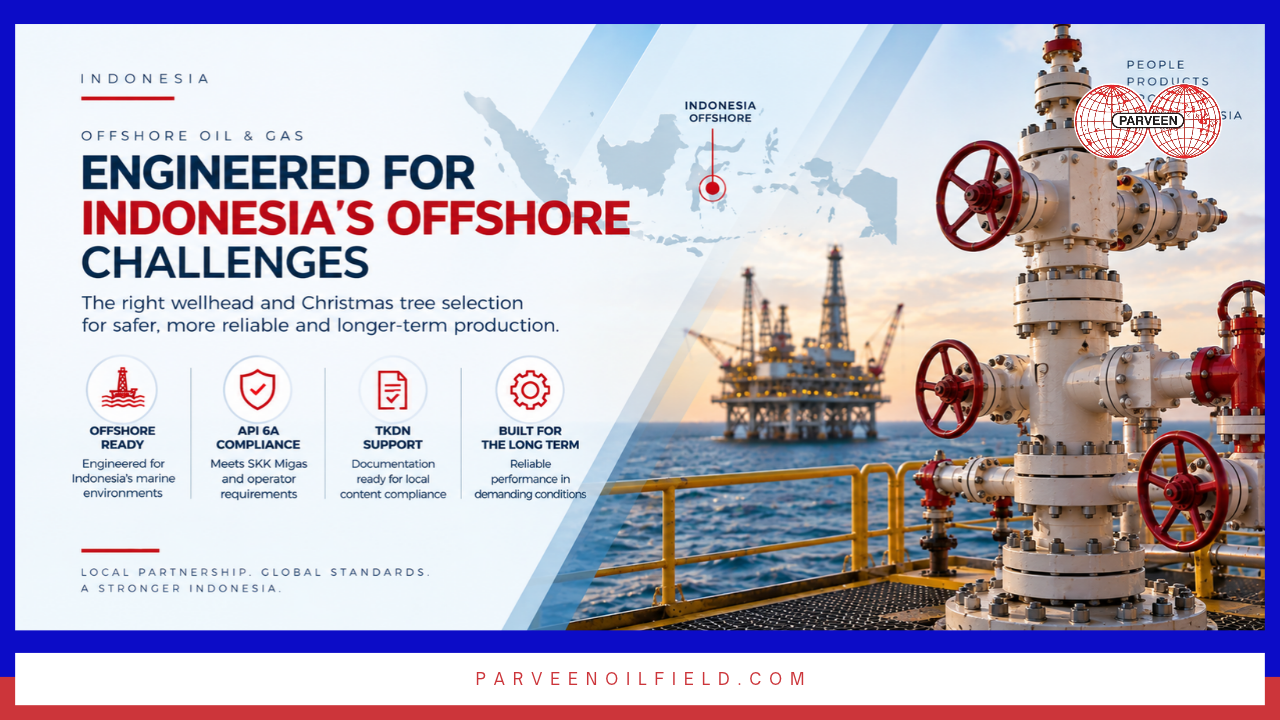
Indonesia’s Offshore Upstream Expansion: The Equipment Selection Context
Indonesia’s offshore upstream sector is active across multiple basins and with a growing roster of PSC operators and national company projects. Eight upstream oil and gas projects came onstream in 2026 under SKK Migas’s program [1], with major producers including Pertamina Hulu Mahakam (60,000 BOPD from East Kalimantan offshore), MedcoEnergi (50,000 BOPD from Natuna and Grissik), BP Berau (40,000 BOPD from Papua), and Eni East Sepinggan (30,000 BOPD from East Kalimantan offshore) [2]. Eni’s Geliga-1 well in the Ganal work area announced a significant gas discovery in early 2026, representing a new addition to Indonesia’s deepwater exploration portfolio [2].
This activity drives demand for offshore wellhead and Christmas tree equipment across a range of basin environments — from the mature, moderate-depth platforms of the Java Sea and Madura Strait to the technically demanding deepwater and high-CO₂ environments of the Natuna Sea and East Kalimantan. Each environment presents different selection criteria, and a wellhead assembly that is correctly specified for one may be wholly inadequate for another.
Two additional regulatory factors shape wellhead equipment selection for Indonesian offshore operators that are not present in all other upstream markets. First, SKK Migas requires that wellhead equipment comply with API 6A as the technical standard for upstream wellhead systems — upstream oil and gas activities in Indonesia require API 6A for wellhead equipment, rather than unique Indonesian standards, consistent across Pertamina and international PSC operators [3]. Second, Indonesian state-owned entities and Pertamina-led PSC operators require Tingkat Kandungan Dalam Negeri (TKDN — Local Content Level) compliance declarations for procurement — a documentation requirement that imported wellhead equipment suppliers must be prepared to address [3].
This guide provides a practical selection framework for Indonesian offshore operators and EPCs evaluating wellhead and Christmas tree equipment for offshore programs.
Selection Factor 1: Pressure Class — Matching Equipment to the Reservoir
The foundational pressure class decision for an Indonesian offshore wellhead follows the same logic as in any upstream environment: select the pressure class from the maximum anticipated wellhead pressure, not the normal flowing pressure. The distinction between Indonesian offshore basins in terms of wellhead pressure requirements is significant:
Java Sea platform wells — producing from relatively shallow, moderate-pressure carbonate and sandstone reservoirs — typically require 3,000 or 5,000 PSI WP wellhead equipment. The Java Sea’s mature fields (Offshore Northwest Java, Offshore Southeast Sumatra) are characterised by wells with moderate initial reservoir pressure and decades of production history that have reduced reservoir pressure further.
East Kalimantan offshore wells — including Pertamina Hulu Mahakam’s Mahakam Block platform wells and the deepwater programs offshore Balikpapan — span a wider pressure range, with some deep gas targets requiring 10,000 PSI WP equipment.
Natuna Sea gas wells — with CO₂-rich reservoirs at significant water depths — require 5,000 to 10,000 PSI WP wellhead equipment, with the CO₂ content driving material selection requirements more significantly than pressure class alone.
Papua deepwater wells (Tangguh LNG supply wells, Bobara PSC) — at 1,700–2,000 metre water depths — require high-pressure, deepwater-capable wellhead systems with subsea-compatible design where applicable.
For all Indonesian offshore programs, the correct approach is to calculate the Maximum Anticipated Wellhead Pressure (MAWHP) from the reservoir engineering data, apply a minimum 25% safety margin, and select the next API 6A standard pressure class above that value. Parveen supplies wellhead and xmas tree assemblies from 2,000 to 15,000 PSI WP for Indonesian offshore service.
Selection Factor 2: Produced Fluid Corrosion — The Indonesian Offshore Differentiator
Indonesian offshore produced fluids span some of the most varied and corrosive compositions in Asia-Pacific. This diversity makes produced fluid corrosion the single most differentiating wellhead selection factor for Indonesian offshore programs — more consequential than pressure class for most applications.
CO₂-Rich Gas Reservoirs (Natuna Sea, Makassar Strait): CO₂ concentrations reaching 70% by volume create extremely aggressive internal corrosion conditions on carbon steel components. Carbonic acid formation from CO₂ dissolved in produced water attacks wellhead internal surfaces, gate valve seats, and tubing head sealing elements. For Natuna Sea wells with high CO₂ content, wellhead and Christmas tree components in contact with the produced stream must be specified in corrosion-resistant alloy (CRA) materials — 13Cr stainless steel as a minimum for moderate CO₂, Super 13Cr or 22Cr duplex for higher CO₂ partial pressures. Parveen’s gate valves and wellhead spool trim are available in CRA materials for Indonesian CO₂ service.
H₂S-Bearing Zones (East Kalimantan, some Makassar Strait formations): Where H₂S co-exists with CO₂, the risk of Sulfide Stress Cracking (SSC) in high-strength steel requires NACE MR0175/ISO 15156 compliant material specification — controlled hardness, heat treatment, and material grade across all metallic components in the pressure boundary.
Marine Atmospheric Corrosion (All Offshore Locations): All Indonesian offshore platform wellhead equipment is exposed to marine atmospheric corrosion on external surfaces — salt aerosol, humidity, and tropical temperature conditions that accelerate corrosion of unprotected steel surfaces. External protection is required for all offshore Indonesian wellhead equipment, in the form of thermal spray aluminium (TSA), marine-grade epoxy/polyurethane coating systems, or equivalent protection rated for the marine exposure severity at each installation.
Sweet Service Wells (Java Sea, Madura Strait): For Indonesian offshore wells producing sweet crude and gas without significant CO₂ or H₂S content, standard carbon steel wellhead materials in API 6A Material Class AA are appropriate. The primary corrosion challenge for these wells is external marine atmospheric corrosion on platform-mounted wellhead equipment.
Selection Factor 3: The Christmas Tree Configuration — What the Offshore Well Needs
The Christmas tree (production tree) for an Indonesian offshore well requires configuration decisions that differ from onshore wellhead selection in several respects:
Valve Count and Redundancy: Offshore production trees in Indonesian operations typically include dual master valves (lower and upper), production wing valve, kill wing valve, and swab valve — the same five-valve configuration used internationally for offshore wells. Dual master valves provide the primary well control redundancy required by international offshore safety standards. For unmanned Indonesian offshore platforms with remote well monitoring, all master and wing valves should be hydraulically actuated with fail-safe close capability, enabling emergency shut-in from the platform control room or from a remote operations centre without requiring personnel on-platform.
Choke Valve for Offshore Production Management: Indonesian offshore production trees for wells with gas or gas condensate production include a choke valve in the tree assembly to manage wellhead flowing pressure and production rate. For East Kalimantan and Natuna Sea gas condensate wells with high CO₂ content and sand production, tungsten carbide trim on the choke valve is required to resist the combined erosive attack of sand and flashing condensate at the choke restriction.
Compact vs Standard Flange Height: Indonesian offshore platform wellhead installations on fixed jackets or FPSOs have specific deck height and weight constraints. The choice between standard flange height wellhead spools (which provide greater vertical clearance above the tubing head for BOP stack during drilling) and compact or low-profile spools (which reduce the total wellhead stack height for space-constrained platform decks) must be confirmed against the platform’s wellhead bay dimensional drawing before specifying.
Gate Valve Actuation for Remote Operations: For offshore Indonesian platforms operating with minimal manning, or for subsea wellheads, hydraulically actuated gate valves with position feedback (open/close limit switches and 4-20 mA position transmitters) allow wellhead monitoring and actuation from a central control location. Parveen’s hydraulic gate valves are available with these actuation and instrumentation features for Indonesian remote-operated offshore wellhead applications.
Selection Factor 4: SKK Migas Documentation and TKDN Compliance
Indonesian upstream oil and gas is regulated by SKK Migas, and upstream wellhead equipment must comply with API 6A as the applicable technical standard. For PSC operators supplying equipment to SKK Migas-regulated projects, documentation requirements include API 6A compliance records, material traceability documentation, and pressure test certificates — consistent with the documentation standards applied internationally for API 6A wellhead equipment.
The TKDN (Tingkat Kandungan Dalam Negeri) local content requirement is specific to Indonesia and affects imported wellhead equipment procurement by Pertamina and state-linked operators. Imported equipment suppliers must be able to provide TKDN assessment documentation — showing the percentage of domestic versus imported content in the product — as a condition of procurement under Indonesian government regulations [3]. This requirement applies to Pertamina subsidiaries and other BUMN (state-owned enterprise) operators, and may also apply to international PSC operators depending on their PSC contract terms.
Parveen provides TKDN documentation assistance for Indonesian operators requiring local content compliance declarations. Buyers are advised to confirm their specific TKDN requirement from their procurement team or SKK Migas compliance advisor before finalising the wellhead equipment purchase order.
Selection Factor 5: Casing Program Compatibility and Application Engineering
As with all wellhead equipment, the final selection must be confirmed for dimensional compatibility with the planned casing program. For Indonesian offshore wells, where the casing program is determined by the geological drilling program, water depth considerations, and any specific cementing or liner hanger requirements, the wellhead bore sizes and hanger profiles must match the specific casing OD and weight for each string.
Indonesian offshore operators — including Pertamina Hulu Mahakam, Eni, and international PSC operators — use both standard API 5CT casing sizes and — in older or non-standard completions — non-standard connection types that require hanger profile modification. Parveen’s application engineering process reviews the operator’s casing program before manufacture and generates a pre-manufacture dimensional drawing for operator approval. For Indonesian offshore wells where the casing program is defined by the drilling contractor and may change between the wellhead procurement stage and the actual drilling operation, Parveen recommends retaining the ability to modify bore configurations up to a defined cut-off point in the manufacturing schedule.
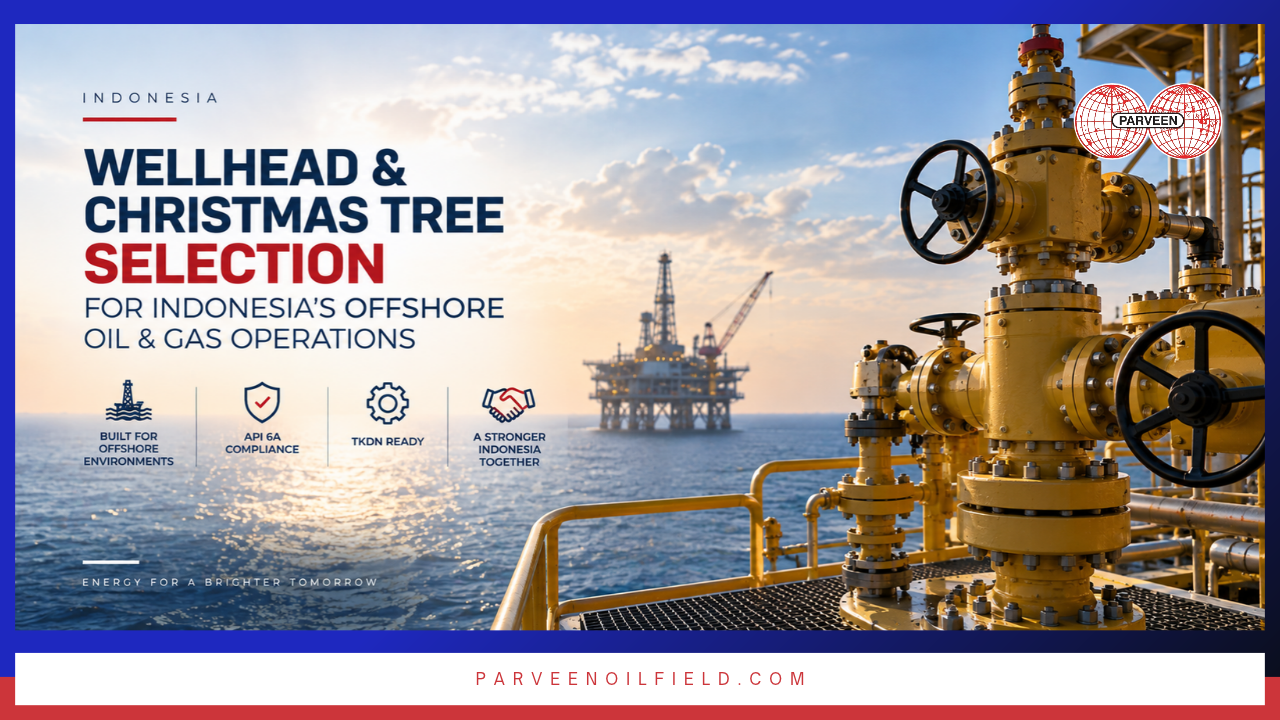
Parveen Industries: API 6A Wellhead and Christmas Tree Equipment for Indonesian Offshore
Parveen manufactures the complete wellhead and Christmas tree assembly for Indonesian offshore service — from casing heads through tubing head spools and tubing head adapters to complete production trees with hydraulic gate valves and adjustable chokes.
Available in pressure ratings from 2,000 to 15,000 PSI WP, PSL 1 through PSL 3, with marine-grade external protection and CRA or NACE-compliant internal materials for corrosive service. Unitised wellheads reduce installation time on offshore platforms. Surface safety valves with hydraulic fail-safe close actuation provide emergency shut-in capability for remote offshore platform operations.
Frequently Asked Questions (FAQs)
Q1. What PSL level is appropriate for Indonesian Java Sea platform wellheads vs deepwater East Kalimantan wellheads? For Java Sea platform wellheads operating in moderate-pressure sweet service — typical of mature Java Sea fields — PSL 2 is appropriate as the offshore baseline, with PR2 pressure testing recommended on all production-service gate valve positions. For East Kalimantan deepwater wells, particularly those with CO₂-rich gas production or H₂S exposure, PSL 3 is the appropriate minimum — adding full NDE of all pressure-containing parts, gas seat testing, and hardness survey documentation that deepwater intervention cost economics demand. Any East Kalimantan well where a wellhead failure would require a deepwater workover vessel mobilisation should be specified at PSL 3 as a minimum.
Q2. How does CO₂ content in Natuna Sea gas wells affect wellhead material selection? CO₂ partial pressure determines whether standard carbon steel wellhead components will corrode at an unacceptable rate in Natuna Sea gas service. When CO₂ partial pressure exceeds approximately 30 psi (consistent with CO₂ concentrations above approximately 5–10% in reservoir gas at wellhead conditions), corrosion-resistant alloy (CRA) trim is required on all wetted surfaces. For Natuna Sea wells with CO₂ concentrations above 30%, full 13Cr stainless steel or Super 13Cr internal trim on gate valves, wellhead seal systems, and tubing head bowl surfaces is required. Parveen’s wellhead and gate valve range for Indonesian CO₂ service includes 13Cr, Super 13Cr, and 22Cr duplex options.
Q3. What is TKDN and how does it affect wellhead equipment procurement in Indonesia? TKDN (Tingkat Kandungan Dalam Negeri) is Indonesia’s local content requirement, mandating that procurement by Indonesian state-owned enterprises and certain PSC contractors include a minimum percentage of locally produced content. For imported wellhead equipment, the supplier must provide a TKDN assessment document declaring the percentage of domestic versus imported content. Different procurement categories have different TKDN targets, and the requirement applies most directly to Pertamina subsidiaries and BUMN-linked operators. Parveen provides TKDN assessment documentation for Indonesian procurement as part of its standard export compliance documentation for Indonesian buyers.
Q4. Can Parveen supply replacement wellhead components for aging Indonesian offshore platform wells? Yes. Parveen regularly supplies dimensionally compatible replacement components for aging Indonesian offshore wellheads — gate valve seal kits, tubing head bowl seals, hanger seal elements, and replacement gate valve assemblies — for platforms where the original manufacturer’s parts are no longer available or have extended lead times. The basis for dimensional compatibility is the existing wellhead’s dimensional datasheet or the well completion record. For Indonesian offshore fields where platform well maintenance programs are rationalising wellhead component suppliers, Parveen can assess compatibility with the installed wellhead fleet from the operator’s wellhead technical data.
Q5. Does Parveen provide factory-assembly and pressure testing of complete wellhead assemblies before shipment to Indonesian offshore platforms? Yes. Complete wellhead assemblies for Indonesian offshore service are factory-assembled and hydrostatically pressure-tested at 1.5× rated working pressure before dispatch. Gate valves are stroked through full open-close travel during the factory test to confirm operation. The complete assembly test record — including test pressure, duration, and pass/fail determination — is supplied with the equipment as part of the SKK Migas-format documentation package. Factory-tested assemblies reduce on-platform installation time and eliminate the risk of connection leaks from field-assembled bolted joints on remote Indonesian offshore locations.
Q6. What are the typical logistics and delivery arrangements for wellhead equipment shipped to Indonesian offshore operators? Parveen ships to Indonesian operators via sea freight to Jakarta (Tanjung Priok), Balikpapan (East Kalimantan), or Sorong (Papua), with standard transit of approximately 18–25 days from manufacturing facility. Full export documentation is provided — commercial invoice, packing list, certificate of origin, API 6A compliance documents, TKDN assessment where required, and material certifications. For urgent offshore drilling programs, airfreight to Balikpapan or Jakarta reduces transit to 3–5 days. Parveen coordinates with the operator’s Indonesian customs and TKDN compliance team to ensure smooth import clearance.
Call to Action
Indonesia’s offshore upstream programs are expanding — from Java Sea platform replacements to East Kalimantan deepwater development and Papua frontier exploration. Every wellhead and Christmas tree installed in those programs is a 25-year commitment. Selecting correctly from the start protects that commitment.
Contact Parveen Industries to discuss wellhead and Christmas tree selection for your Indonesian offshore program. Submit your casing program, fluid composition, and platform specifications for application engineering review.
📧 Visit parveenoilfield.com/id/ to request a technical consultation or submit your equipment inquiry.
Parveen Industries — API-Compliant. TKDN-Ready. Indonesia Offshore–Specified.
Data Sources & References
[1] SKK Migas’s eight upstream oil and gas projects targeted to come onstream in 2026 with USD 478 million combined capex — reported by Tempo.co citing SKK Migas Head Djoko Siswanto in a hearing with House of Representatives Commission XII on February 11, 2026 (https://en.tempo.co/read/2086575/indonesia-to-bring-eight-oil-and-gas-projects-onstream-in-2026) and by Energies Media (https://energiesmedia.com/skk-migas-indonesia-oil-and-gas-projects/).
[2] Indonesia’s top upstream operators and their production volumes — Pertamina Hulu Mahakam at 60,000 BOPD, MedcoEnergi at 50,000 BOPD, BP Berau at 40,000 BOPD, Eni East Sepinggan at 30,000 BOPD — and Eni’s Geliga-1 gas discovery in the Ganal work area in early 2026, are from LDI Training’s Top 10 Oil Producers in Indonesia 2026 compilation citing SKK Migas Q1 2026 data (https://oilandgascourses.org/top-10-oil-producers-in-indonesia-2026/).
[3] The regulatory framework under SKK Migas requiring API 6A compliance for upstream wellhead equipment in Indonesian PSC operations, and the TKDN (Tingkat Kandungan Dalam Negeri) local content documentation requirement for Pertamina and state-linked procurement, are described in Vajra Industrial’s valve supplier Indonesia regulatory guide published May 2026 (https://www.vajravyuh.com/blog/valve-supplier-indonesia) and in the Indonesia Oil & Gas Comparative Guide by Mondaq/Chambers (https://www.mondaq.com/guides/results/38/1101/all/indonesia-oil-gas).