
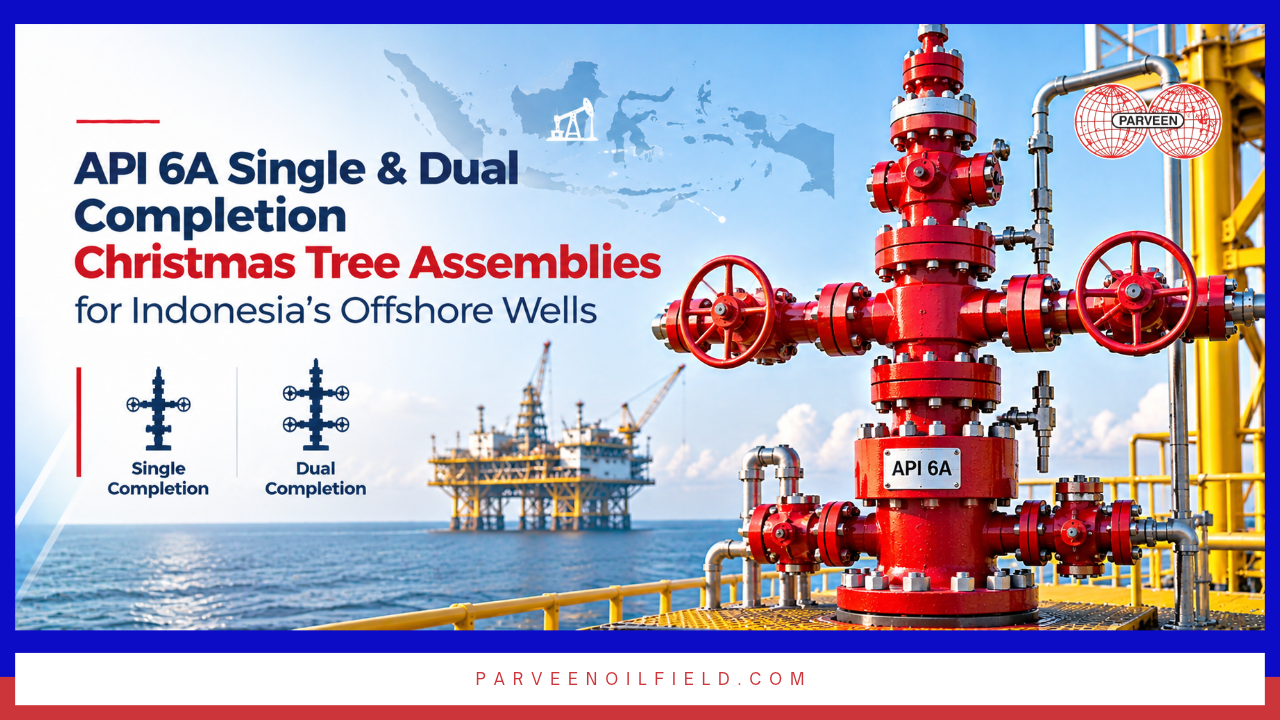
Executive Summary
Indonesia remains one of Southeast Asia’s most significant oil and gas producing nations, with an active upstream sector spread across Sumatra, Kalimantan, the Java Sea, and Papua. SKK Migas, the upstream regulatory body, has set a target of 1 million barrels of oil equivalent per day by 2030, requiring substantial new drilling and completions activity across both onshore and offshore basins [1]. The country’s gas sector, essential for domestic power generation and LNG exports, is anchored by assets including the Mahakam block in East Kalimantan, the Masela deep-gas development in the Banda Sea, and a growing portfolio of PSC blocks awarded to Pertamina and international partners [2]. As Indonesia accelerates its upstream programme, the selection of correct wellhead equipment, and in particular the Christmas tree assembly that sits at the top of every producing well’s surface wellhead, is a primary execution risk for procurement teams and completion engineers.
A Christmas tree assembly is not a single component but a matched assembly of wellhead valves, spools, and connections designed as an integrated surface pressure containment and flow control system. For Indonesian offshore wells, where the Christmas tree may be accessed by barge or platform in remote deepwater locations, specifying the wrong bore size, an inadequate pressure class, or a mismatched flange profile creates installation problems that cannot be remedied quickly. For dual completion wells, the added complexity of two independent tubing strings and two valve sets passing through a shared wellhead envelope magnifies the consequences of a specification error.
Parveen Industries manufactures API-Compliant single and dual completion wellhead and Christmas tree assemblies designed to API Specification 6A (21st Edition). With three decades of manufacturing experience and supply capability to Southeast Asian oil and gas projects, Parveen provides wellhead assemblies for Indonesian offshore operators, completion contractors, and EPC companies.
This article covers the engineering of Christmas tree assemblies under API 6A, the design differences between single and dual completion configurations, bore and pressure class selection for Indonesian offshore conditions, and the product options available from Parveen Industries for Indonesian wellhead procurement.
Christmas Tree Assemblies Under API 6A: Structure and Function
A Christmas tree assembly is the topmost component of the surface wellhead stack. It is bolted directly to the top of the tubing head spool and provides the primary flow control and isolation capability for a producing well at surface. The name derives from the resemblance of the stacked valve bodies and cross-connections to the outline of a conifer tree.
Under API Specification 6A, Christmas tree bodies, valves, spools, and flanges are all classified as wellhead equipment and subject to pressure class, temperature class, material class, and PSL requirements [3]. The tree assembly must be designed and tested as a system, not as a collection of individual valves, with all inter-connecting flanges, spools, and crosses confirmed to the rated working pressure.
Valve Configuration of a Christmas Tree
A standard single completion Christmas tree comprises the following valve elements arranged in a defined order from the tubing head flange to the top:
The lower master valve (LMV) is the first valve above the tubing head. It is a full-bore gate valve that provides the primary isolation between the tubing head and the tree above. It is normally open during production but can be closed for well shut-in and tree maintenance access.
The upper master valve (UMV) is a second full-bore gate valve stacked above the LMV. It provides a redundant primary barrier at the lower part of the tree. Normal operating practice keeps both master valves open during production, with one available for closure if the other requires maintenance.
Above the master valves, the tree cross connects the main bore to the production wing and the kill-side wing. The production wing valve (PWV) is a gate valve on the production outlet, through which well fluids are directed to the production flowline. The kill-side wing valve (KWV) is on the opposite side of the cross, used for pumping kill fluid into the well for killing operations and pressure testing.
The swab valve sits at the top of the tree, on the main bore above the master valves. It is a full-bore valve that is closed during normal production and opened only for wellbore access: wireline operations, coiled tubing, or pump-down perforating. Its bore must be large enough to pass the largest intervention tool designed for the well.
The production choke is typically installed on the production wing, downstream of the production wing valve. It throttles the flow from the well to the gathering system and sets the production rate.
Single Completion Christmas Trees: Configuration and Selection
A single completion Christmas tree is designed for a well with one production tubing string. All well fluids from a single productive zone, or from commingled production from multiple zones in the same wellbore without zone-selective control, flow through one tubing string into the tree. This is the standard configuration for the majority of Indonesian offshore oil and gas wells.
The bore of a single completion tree is determined by the production tubing OD and the tubing hanger OD. For Indonesian offshore gas wells in the Mahakam block and similar Eastern Indonesia assets, 3-1/2 inch or 4-1/2 inch production tubing is common, requiring a tree bore of 7-1/16 inch or 9-inch (at higher pressure classes) to allow hanger passage and intervention access. Oil producers in shallower Java Sea fields running smaller tubing may use a 5-1/8 inch tree bore.
The working pressure class of a single completion tree is selected based on the anticipated shut-in wellhead pressure (SIWHP). For Indonesian gas fields with high reservoir pressures, particularly in the Banda Sea (Masela/Abadi LNG project) and deep East Kalimantan blocks, 5,000 to 10,000 psi tree equipment is specified. Shallower Java Sea oil producers typically require 2,000 to 3,000 psi wellhead equipment.
A single completion tree for an Indonesian offshore platform well typically includes the master valves, wing valves, swab valve, and choke valve as an integrated assembly with the bottom flange matched to the tubing head spool top flange. The assembly is configured with API 6A ring-groove flanges (BX gaskets) at all connection points and pressure-tested as a complete assembly before shipment to verify seal integrity at the rated working pressure.
Dual Completion Christmas Trees: Engineering for Two Independent Tubing Strings
A dual completion Christmas tree is designed for a well that produces from two separate zones through two independent production tubing strings simultaneously, without commingling the zones at the wellhead. Each string has its own pressure integrity, its own production measurement, and its own shut-in capability. The two strings pass through a shared tubing head spool and exit through the dual completion Christmas tree above, each with its own independent valve set.
Dual completion trees are more mechanically complex than single completion trees. The tree body must accommodate two parallel tubing strings side-by-side through a single tree cross, requiring a wider body, larger flange OD, and more careful bore layout design. Each string has its own master valves, wing valves, and production outlet, all within the shared tree envelope.
Indonesian applications for dual completion trees include fields where two reservoirs at different depths are developed through the same wellbore: the lower string produces the deeper reservoir while the upper string produces the shallower one. This is relevant in some of Indonesia’s mature fields in Central Kalimantan and Sumatra, where multiple pay zones exist in the same structure and dual completion reduces the number of wells required to develop the full field.
A dual completion tree must be specified with the pressure class appropriate for the higher-pressure string, since both strings are contained within the same tree body. If the upper zone produces at 2,000 psi and the lower zone at 5,000 psi, the entire tree assembly must be rated to 5,000 psi. The bore of each string’s tubing hangers and master valves must be independently sufficient for the intervention requirements of that specific string.
Material and PSL Selection for Indonesian Offshore Conditions
Indonesian offshore production environments span a wide range of conditions: benign, non-corrosive oil production in the Java Sea; sour gas and CO2-bearing condensate in the eastern fields; high-pressure, elevated-temperature gas wells in deepwater blocks; and tropical atmospheric conditions for all surface wellhead equipment.
For non-sour Indonesian oil fields, Material Classes AA through DD under API 6A cover the temperature range encountered, and PSL 1 or PSL 2 is appropriate for standard wells. For sour-gas fields with H2S, Material Class FF with PSL 3 is the minimum specification, with NACE MR0175 / ISO 15156 compliance required for all wetted components in the Christmas tree.
For Indonesian deepwater applications, PSL 3 is typically the minimum PSL requirement, with PSL 4 specified for HPHT wellheads where reservoir conditions and water depth combine to create the highest criticality service. SKK Migas and Pertamina’s well design standards typically align with international operator standards for deepwater PSL specification, drawing from API, ISO, and operator-specific well design requirements.
External corrosion protection for surface Christmas trees on Indonesian offshore platforms and barges should address the tropical marine environment: continuous humidity, salt spray, UV exposure, and elevated temperature. Epoxy primer with polyurethane topcoat systems, applied to API-specified surface preparation standards (SSPC-SP10 or equivalent), are typical for offshore tree exteriors.
Wellhead and Christmas Tree Sizing for Indonesian Well Programmes
Sizing a Christmas tree assembly for an Indonesian offshore well programme requires coordination between the completion design, the tubing programme, and the production flow assurance design. Key sizing decisions include:
Bore size: Determined by the OD of the production tubing hanger. If a 4-1/2 inch tubing string is planned with a 6.4-inch mandrel hanger OD, the tree bore must be at least 6.4 inches in the through-bore of the lower master valve. For wells with a planned wireline or coiled tubing intervention programme, the minimum passing bore of the swab valve must accommodate the largest tool OD.
Outlet and wing valve size: The production wing valve size determines the maximum flow capacity through the tree. For high-rate Indonesian gas wells, an undersize production wing restricts production deliverability. API 6A defines standard wing valve sizes for each tree bore/pressure class combination; specifying a larger wing valve than standard requires custom tree engineering.
Pressure class: As described above, matched to the SIWHP of the well. For exploratory wells in unproven Indonesian blocks, an adequate safety margin above estimated SIWHP is applied.
Top connection: The swab valve top connection must accept the wellhead adapter or cap required for the well’s planned intervention programme. For subsea intervention on some Indonesian deepwater wells, the top connection profile must match the intervention tool’s connector design.
Parveen Industries’ Christmas Tree Assemblies for Indonesian Offshore Wells
Single and Dual Completion Wellhead and Christmas Tree Assemblies: Parveen Industries manufactures single and dual completion wellhead and Christmas tree assemblies for Indonesian offshore applications. Each assembly is configured to customer-specified bore sizes, pressure class, temperature class, and outlet configuration, then pressure-tested as a complete unit at the rated working pressure before shipment. Single completion assemblies for standard Indonesian offshore oil and gas producers and dual completion assemblies for multi-zone developments are both available. Bottom flange configuration is matched to the installed or planned tubing head spool to ensure dimensional compatibility on delivery to the installation site.
Choke Valve: The production choke on the Christmas tree’s production wing is part of the integrated wellhead and tree package. Parveen’s adjustable choke valve, available in pressure classes to 10,000 psi, is supplied as part of the tree assembly or as a standalone component for operator-specified installations. Tungsten carbide trim options are available for Indonesian gas condensate wells with incipient sand production or high-velocity erosive flow.
Surface Safety Valve: Parveen’s surface safety valve, fail-safe closed and hydraulically actuated, is integrated into the Christmas tree package for Indonesian wells requiring ESD functionality at the production wing outlet. The SSV connects to the platform or wellhead pad ESD hydraulic system and closes automatically on hydraulic pressure loss.
Slab Gate Valve: Where individual gate valves are required for master valve or wing valve service within the Christmas tree assembly, Parveen supplies API 6A slab gate valves in sizes and pressure classes appropriate to Indonesian wellhead service.
SSSV and TRSV: For Indonesian offshore platform and deepwater wells where a subsurface safety valve is required as a downhole barrier in addition to the surface tree’s SSV, Parveen supplies surface-controlled subsurface safety valves (SSSVs) and tubing retrievable safety valves (TRSVs) for tubing-string installation below the wellhead.
The full Parveen product range for Indonesian offshore wellhead applications is at the Indonesia wellhead and product category and Indonesia all-products page.
Case Illustration: Dual Completion Christmas Tree for a Mahakam Block Well
An operator working in the Mahakam block in East Kalimantan is planning a dual completion well targeting two gas-bearing sandstone reservoirs at approximately 1,800 metres and 2,100 metres depth. The shallower zone produces dry gas at a shut-in wellhead pressure of 2,500 psi. The deeper zone produces wet gas and condensate at a shut-in wellhead pressure of 4,200 psi. Both zones are non-sour, with CO2 content below 2 percent.
The completion plan calls for two 3-1/2 inch production tubing strings run simultaneously to the two respective zones, isolated from each other with a dual-string packer and tail pipe assembly. The dual completion Christmas tree must accommodate both tubing strings through a shared tree body, with each string having its own master valve set, wing valve, and production outlet.
The procurement specification calls for a 5,000 psi working pressure tree (above the higher zone’s SIWHP of 4,200 psi), Material Class DD (non-sour, standard service), PSL 2, with two 3-1/2 inch nominal tubing string bores through the dual tree body and 2-9/16 inch API wing outlets on each production wing. The external coating is specified for offshore tropical conditions.
Parveen Industries supplies the dual completion wellhead and Christmas tree assembly configured to this specification, pre-tested as a complete unit at 7,500 psi hydrostatic (1.5 times the 5,000 psi working pressure) before shipment to the Mahakam offshore installation barge. The assembly is dimensionally confirmed against the tubing head spool already installed on the platform wellhead deck to verify that the bottom flange profile and bore match the tubing head top flange before the barge departs the supply base.
The dual tree is installed in a single rig operation, landing the assembly on the tubing head with a crane from the installation barge. Both tubing strings are run sequentially through the dual tree bore in the following weeks, landing the respective zone hangers in the tubing head below and sealing off both tubing-casing annuli. The first gas is achieved on schedule with both production strings independently measured on the platform test separator.
Frequently Asked Questions
Q1: What is a Christmas tree assembly and what are its main components under API 6A?
Under API Specification 6A, a Christmas tree (X-mas tree) assembly is the topmost surface wellhead component that provides primary flow control and isolation for a producing well. Its main components are the lower master valve (LMV), the upper master valve (UMV), the production wing valve (PWV), the kill-side wing valve (KWV), the swab valve at the top (for wireline and coiled tubing access), and the production choke on the production wing outlet. These components are arranged in a specific sequence on the tree body and cross, flanged with API 6A ring-groove (BX) connections, and rated to a consistent working pressure class throughout. API 6A governs the design, manufacture, materials, PSL, and testing requirements for all Christmas tree components.
Q2: What is the difference between a single completion and a dual completion Christmas tree for Indonesian offshore wells?
A single completion Christmas tree is designed for a well with one production tubing string, producing from one or multiple commingled zones through a single bore. It has one master valve set, one wing valve set, and one production outlet. A dual completion Christmas tree accommodates two independent production tubing strings side-by-side within a shared tree body, each with its own independent master valves, wing valves, and production outlets. Dual completion trees are used when two separate reservoir zones must be produced independently through the same wellbore without commingling. They are physically larger, more mechanically complex, and more expensive than single completion trees, and their specification must address the higher-pressure string for the entire assembly’s working pressure class.
Q3: What API 6A pressure class Christmas tree is specified for Indonesian deepwater wells?
For Indonesian deepwater wells targeting high-pressure reservoirs in the Banda Sea, Masela, or deepwater East Kalimantan blocks, 10,000 psi working pressure Christmas trees are standard. Some deepwater HPHT wells may require 15,000 psi rated equipment. For shallower offshore and onshore wells in the Java Sea and Sumatra, 2,000 to 5,000 psi working pressure is typical. The pressure class is selected to equal or exceed the maximum anticipated shut-in wellhead pressure of the well, with a safety margin applied for exploratory wells. The working pressure class of the Christmas tree must match the working pressure class of the tubing head spool below and the production flowline above.
Q4: What bore size should be specified for a Christmas tree installed on an Indonesian offshore gas well?
The bore size of a Christmas tree for an Indonesian offshore gas well is determined by the OD of the production tubing hanger that must pass through the tree body when running the tubing string, and by the size of intervention tools planned for future wireline and coiled tubing operations on the well. For 3-1/2 inch production tubing, which is common in East Kalimantan gas wells, a minimum 7-1/16 inch tree bore at 5,000 psi working pressure is typical. For 4-1/2 inch tubing in higher-rate gas wells, a larger bore is specified. The swab valve top bore must also accommodate the largest tool OD planned for intervention, including through-tubing perforating guns or logging tools.
Q5: When is a dual completion Christmas tree preferred over drilling two separate wells in Indonesian fields?
A dual completion Christmas tree is preferred when the two productive zones are closely spaced in depth, the wellbore trajectory can reach both zones from a single well location, the platform or wellhead pad has limited slot availability, or the development economics favour a dual completion over two separate wells. In Indonesia’s mature gas fields in Kalimantan and Sumatra, where reservoir compartments at different depths can be targeted from the same well location, dual completions can reduce total well count, reduce platform slot requirements, and lower development capital costs relative to drilling two separate wells. The technical constraint is that both zones must be mechanically and hydraulically separable by packer, since the dual completion system requires independent annular isolation between the two tubing strings.
Q6: Can Parveen supply both the tubing head and the Christmas tree as a matched wellhead package for Indonesian operators?
Yes. Parveen Industries supplies complete wellhead packages for Indonesian offshore applications, including the tubing head spool, tubing hanger, and Christmas tree assembly as a matched set with all flanges, bores, and ring-groove profiles dimensionally verified before shipment. Package supply eliminates the dimensional compatibility risk of sourcing the tubing head and tree separately and simplifies the documentation package for SKK Migas compliance and project QA requirements. Packages are configurable for single and dual completion wells in pressure classes from 2,000 psi through 10,000 psi, with PSL and material class options to suit standard and sour-service Indonesian formations. Subsurface safety valve packages (SSSV and TRSV) can also be included as part of the integrated wellhead supply.
Source Christmas Tree Assemblies for Your Indonesian Offshore Well Programme
Indonesia’s offshore and deepwater upstream programme, anchored by SKK Migas’s 1 million boe/day target and an expanding PSC block portfolio, creates a sustained requirement for Christmas tree assemblies that perform reliably through the full producing life of each well. Whether specifying a single completion tree for a standard platform well or a dual completion assembly for a multi-zone Kalimantan gas field, the dimensional precision, pressure class confirmation, and pre-shipment testing of the Christmas tree assembly directly determines whether the wellhead performs as designed from first production to field abandonment.
Parveen Industries is an API-Compliant manufacturer of single and dual completion wellhead and Christmas tree assemblies, tubing head spools, gate valves, choke valves, and surface safety valves, with direct supply capability to Indonesian offshore operators, completion contractors, and EPC procurement teams.
Email: info@parveenoilfield.com Website: https://parveenoilfield.com/id/
Explore the full Indonesian wellhead and Christmas tree product range at https://parveenoilfield.com/id/products/.
Data Sources & References
[1] SKK Migas Upstream Oil and Gas Target 1 Million BOE Per Day by 2030. SKK Migas, 2025. https://www.skkmigas.go.id
[2] Indonesia Gas Sector Overview: Mahakam, Masela, and Deepwater PSC Development. Rystad Energy / Indonesia Ministry of Energy and Mineral Resources, 2025. https://www.esdm.go.id
[3] API Specification 6A, Specification for Wellhead and Tree Equipment, 21st Edition. American Petroleum Institute. https://www.api.org/products-and-services/standards/important-standards-and-initiatives/standards-6a
[4] NACE International Standard MR0175 / ISO 15156, Petroleum and Natural Gas Industries, Materials for Use in H2S-Containing Environments in Oil and Gas Production. NACE International. https://www.nace.org
[5] Indonesia Upstream Investment and PSC Award Programme. KESDM (Ministry of Energy and Mineral Resources), 2026. https://www.esdm.go.id/en/