

Beyond Type Selection: Why Engineering Consideration Drives Niger Delta Packer Performance
August’s buyer guide on this platform addressed the primary type selection decision for production packers in Nigerian wells — permanent versus retrievable, mechanical-set versus hydraulic-set, and the elastomeric compound choices for CO₂-rich Niger Delta service. September’s guide goes deeper: into the engineering considerations that must shape the packer specification before the type decision can be correctly made.
In the Niger Delta, the engineering context of each well determines whether any packer design will succeed — regardless of how well the type and compound are matched. Wells in the Agbada Formation’s stacked pay sequences require a zonal isolation architecture, not just a packer. Wells with sand production problems require a packer specification that is compatible with the sand control system — because a packer that cannot co-exist with a gravel pack or standalone screen is not a viable option, however well its sealing specification reads on a datasheet. Wells with significant horizontal deviation require setting tool designs and packer features that function reliably at high inclinations. And the economics of well intervention in Nigeria — where a workover costs USD 500,000 to USD 3 million and the security environment adds further complexity to every rig mobilisation — mean that getting the engineering right at specification stage is not a quality aspiration. It is an economic imperative.
This guide addresses five key engineering considerations that Niger Delta operators and completion engineers must evaluate before specifying production packers.
Engineering Consideration 1: Zonal Isolation Architecture in Stacked Pay Sequences
The Agbada Formation of the Niger Delta hosts one of Africa’s most prolific petroleum systems, but its productivity is distributed across multiple thin, stacked sandstone reservoirs separated by interbedded shales. A typical Niger Delta development well may penetrate five to ten discrete pay intervals within a gross interval of 300–800 metres. How these intervals are isolated from each other — and from non-productive water-bearing zones — directly determines well production rate, water cut trajectory, and the economic recovery from the field.
The zonal isolation architecture specifies where packers are set in the completion string, which intervals are open to production, which are temporarily isolated by bridge plugs for deferred development, and how artificial lift and gas lift systems are integrated into the multi-zone completion. This architecture must be established by reservoir engineering — using reservoir simulation, pressure-depth data, and fluid composition analysis from offset wells — before packer specifications can be written.
The common Niger Delta scenarios and their packer architecture implications are as follows. A single-zone selective completion targets one productive interval with a packer above and below the perforated interval, isolating the producing zone from water-bearing formations above and below. This is the simplest case, but it requires that the packer above the producing zone reliably contains the pressure differential between the producing interval and any overlying zone — which may be a water-bearing formation at significantly different pressure. A stacked multi-zone selective completion targets multiple productive intervals sequentially with packers between each zone, allowing production from each interval to be individually managed. This architecture uses the greatest number of packers and requires careful hydraulic analysis to ensure that pressure differentials between zones do not load the packers beyond their differential pressure rating. A commingled completion produces multiple intervals simultaneously through a single tubing string, with packers providing isolation from non-productive zones only. This is a lower-cost architecture but sacrifices individual zone management capability.
For each architecture, Parveen’s completion engineering team reviews the reservoir engineering data before specifying the packer — confirming differential pressure loads, depth of setting, wellbore temperature profile, and fluid composition at each packer setting depth. This engineering review, not a catalogue selection, is what produces a packer specification that holds for twenty years in a Niger Delta well.
Engineering Consideration 2: Sand Control Integration
Sand production in Niger Delta wells is a pervasive completion challenge that affects packer selection in ways that are frequently overlooked. When a packer is specified independently of the sand control system — or when sand control is added to a completion that was originally designed without it — dimensional compatibility problems, differential pressure rating mismatches, and setting tool interference can all prevent the packer from being set correctly or functioning as designed.
The principal sand control methods used in Niger Delta wells each have specific implications for packer design and selection. Internal gravel pack (IGP) completions — which SPE studies confirm provide WIQI (Well Inflow Quality Indicator) values of 0.74–0.94 and maintain effectiveness for 6–10 years before significant sand production resumes [1] — use a gravel-filled annular space between the screen and the casing, plus a packer above the gravel pack to isolate the producing zone from the zone above. The packer in this configuration must have an OD compatible with the gravel pack equipment in the casing annulus and must be capable of being set below the upper gravel pack extension without interfering with the gravel placement operation. This dimensional interaction is not addressable at the time of packer delivery — it must be designed into the packer specification before manufacture.
Standalone screens without gravel packing require a packer above and below the screen interval to isolate the screened zone from adjacent intervals. The packer’s minimum drift diameter must allow the screen assembly to be run through it, and the screen’s OD must be compatible with the packer’s set configuration in the casing. Dual-zone gravel pack completions — the preferred sand control approach in Niger Delta wells with multiple unconsolidated sand intervals [2] — involve complex sequences of gravel pack, isolation, and packer-setting operations that require detailed planning of the packer types, setting sequences, and tool compatibility across the full completion string.
Engineering Consideration 3: Wellbore Deviation and Setting Tool Compatibility
Niger Delta producing wells span a wide range of wellbore inclinations — from vertical onshore wells in the swamp areas to moderately deviated wells (20–50 degrees) accessing multiple reservoir intervals from a single wellhead location, to highly deviated and horizontal wells used in water-drive reservoir management programs. The packer’s setting mechanism must be confirmed as compatible with the planned wellbore inclination.
For mechanical-set packers — which rely on tubing rotation or reciprocation from surface to actuate the setting mechanism — wellbore inclination above approximately 30–35 degrees from vertical substantially reduces the accuracy of torque and weight transmission to the packer. In highly deviated wells, mechanical-set packers may not set reliably because the tubing cannot transmit the required torque without the string twisting or spiralling in the wellbore. SPE horizontal completion papers from the Niger Delta confirm this issue: openhole completions in Niger Delta horizontal wells face the challenge of tubing torque and drag that prevents mechanical-set tool actuation in high-inclination sections [3].
Hydraulic-set packers, by contrast, are actuated by hydraulic pressure applied through the tubing bore — a force that is transmitted reliably regardless of wellbore deviation. For Niger Delta wells with inclinations above 30 degrees from vertical, hydraulic-set packer designs — whether retrievable or permanent — should be the default specification. Parveen’s hydraulic-set production packers are designed for reliable operation across the full range of Niger Delta wellbore inclinations, including near-horizontal completions in reservoir management programs.
The setting tool design must also be confirmed for compatibility with the completion string below the packer — particularly where gravel pack equipment, screens, or other completion tools are run on the same string as the packer. Setting tool length, OD, and interface connection must be reviewed against the full bottom-hole assembly configuration.
Engineering Consideration 4: Differential Pressure Rating Under Producing Conditions
A packer’s published working pressure rating is typically the differential pressure it can sustain across its sealing element — not the absolute wellbore pressure it operates in. In a Niger Delta multi-zone completion, the differential pressure across each packer is determined by the pressure difference between the zones above and below the packer at any point in the producing life of the well — and this differential can change significantly as reservoir pressure declines at different rates in different zones.
For a packer isolating a high-pressure producing zone below from a depleted or water-bearing zone above, the pressure differential at initial production may be modest, but it may increase substantially as the producing zone depletes and the zone above maintains its pressure (for example, from water influx). If this evolving differential pressure scenario is not modelled at the completion design stage and the packer’s differential pressure rating is not confirmed to accommodate the maximum anticipated differential across the full producing life, the packer will fail before the well reaches economic limit — not from elastomeric degradation but from mechanical overload of the seal element.
Parveen’s completion engineering team requires pressure-depth data for all zones in the completion interval, at initial conditions and at forecast conditions for the planned producing life, before confirming packer differential pressure rating adequacy. This requirement is not administrative — it is the technical basis for ensuring that the specified packer has adequate mechanical integrity for the actual well conditions it will experience.
Engineering Consideration 5: Completion Sequence and Operational Logistics
Niger Delta well completions are more logistically constrained than completions in many other upstream environments. Rig costs are elevated by the security environment, weather windows in the swamp and shallow offshore areas are a constraint for barge-accessed locations, and crew change logistics add cost and scheduling complexity to every completion operation. These logistics constraints mean that the completion sequence — the order in which packer, sand control, tubing, and wellhead components are run — must be planned to minimise the number of trips in and out of the wellbore, and each trip must succeed first-time because a failed trip means another mobilisation at full cost.
Packer specifications must account for the completion sequence requirements. A packer that cannot be set in a single trip in conjunction with the tubing string and wellhead equipment requires a dedicated setting trip — an additional cost that may be avoidable with a different packer design. A retrievable packer that can be released and reset in the event of an incorrect first-setting is more forgiving of surface operational errors than a permanent packer that requires milling to release — a significant consideration in Nigeria’s logistically constrained completion environment.
Dual-zone gravel pack completions in Niger Delta marginal field wells have been shown to require 12–14 days using conventional multi-trip techniques, with total costs that challenge field economics [2]. Alternative completion techniques that reduce the number of trips and the total completion cycle time — including combined gravel pack and packer-setting tools that accomplish multiple functions in a single run — directly address the logistical economics of Niger Delta marginal field development.
Parveen’s production packer range for Nigerian service includes retrievable designs suitable for single-trip packer-and-tubing running sequences, and permanent designs for maximum reliability in completions where workover avoidance across the well’s full life is the priority. Cement retainers and bridge plugs complement the packer range for remedial cementing and zone abandonment programs.
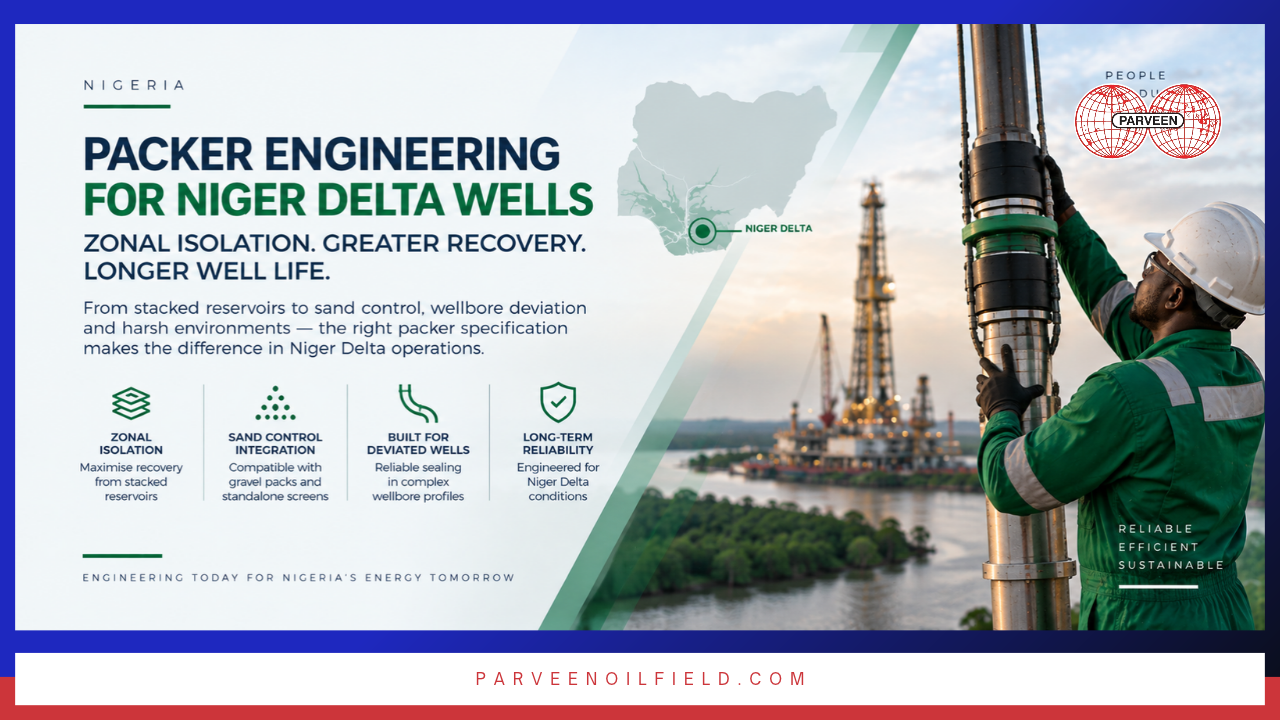
Parveen Industries: Application-Engineered Production Packers for Niger Delta Wells
Parveen Industries’ production packer capability for Nigeria extends beyond catalogue supply to genuine application engineering — reviewing each well’s zonal isolation architecture, sand control system design, wellbore deviation profile, and completion sequence logistics before specifying the packer. This is the difference between a packer that holds for twenty years and one that requires a workover at year three.
Production Packers: Hydraulic-set retrievable and permanent designs for Nigerian service. HNBR element standard, AFLAS available for elevated temperature or severe sour service. Dimensional compatibility confirmation with sand control equipment before manufacture.
Gas Lift Equipment: Side pocket mandrels and wireline-retrievable gas lift valves dimensionally compatible with production packer string.
Bridge Plugs: Wireline-set drillable designs for zone abandonment and temporary isolation in Niger Delta multi-zone completions.
Wellhead and Xmas Tree Equipment: Complete wellhead assemblies compatible with the completion string configuration, with gate valves and surface safety valves for NUPRC-compliant wellhead integrity.
Frequently Asked Questions (FAQs)
Q1. How does sand control method selection affect the packer specification for a Niger Delta well? The sand control method determines the dimensional constraints within which the packer must operate — specifically the casing ID available for packer setting (which is reduced by gravel pack screen OD), the sequence in which the packer and sand control equipment are run, and the forces that the packer must resist during and after gravel placement operations. An IGP completion requires the packer above the gravel pack to be sized for the casing ID with the screen and gravel installed; a standalone screen completion requires a smaller minimum drift diameter than an IGP because there is no gravel pack to account for. Parveen’s completion engineering team confirms dimensional compatibility between the packer and the planned sand control system before manufacture.
Q2. When is a hydraulic-set packer required instead of a mechanical-set design for Niger Delta wells? Hydraulic-set packers are required in any Niger Delta well where wellbore inclination exceeds approximately 30–35 degrees from vertical, because tubing rotation and weight-set transmission are unreliable at higher inclinations. They are also preferred for wells where the tubing string length or weight above the packer is insufficient to apply the set-down force required by a mechanical-set design, and for wells where the completion sequence does not permit tubing rotation (for example, where a downhole motor or directional assembly is still in the hole). In Nigeria’s highly deviated water-drive reservoir management wells and in horizontal completions, hydraulic-set packers are the only technically viable option.
Q3. How should differential pressure between stacked pay zones be accounted for in Niger Delta packer specification? Differential pressure across the packer — the pressure difference between the zones above and below the packer at any point in the producing life — must be calculated from the reservoir engineering model for the well, at initial conditions and at forecast conditions for the maximum anticipated differential during the producing life. The packer must be rated to the maximum anticipated differential with a safety margin of 15–20% above the calculated peak value. If the reservoir engineering model shows that differential pressure will increase significantly as the producing zone depletes (while an overlying zone maintains pressure from water influx), the packer must be rated for the late-life maximum differential, not the initial conditions differential.
Q4. How does Parveen handle application engineering for complex multi-zone Niger Delta completions? Parveen’s completion engineering process for multi-zone Niger Delta completions begins with a review of the reservoir engineering data — zone pressures, depths, fluid compositions, and production forecast — and the completion design architecture, including sand control method, gas lift system, and completion sequence. The engineering review confirms packer placement depths, differential pressure loads at each packer position, setting mechanism suitability for the wellbore inclination, dimensional compatibility with sand control equipment, and completion sequence logistics. This review is completed before manufacturing begins and the results are submitted to the operator for review and approval.
Q5. What API 11D1 validation grade is required for Niger Delta stacked multi-zone completions? V3 validation grade is the minimum appropriate for liquid-service Niger Delta production wells, confirming that the packer design has been tested under temperature cycle conditions simulating the well’s thermal profile. For zones with confirmed gas production or gas-bearing intervals above the packer — where a gas-tight annular seal is required to prevent gas migration between zones — V0 validation grade (gas-tight, tested with gas medium at rated pressure with zero permissible leakage) is appropriate. The determination of required validation grade should be made zone-by-zone based on the fluid composition at each packer position in the multi-zone completion string.
Q6. Can Parveen supply a complete Niger Delta completion package — packers, gas lift mandrels, bridge plugs, cement retainers, and wellhead equipment — for a single-vendor procurement? Yes. Parveen’s Nigerian product range covers the full completion string for a Niger Delta well: production packers, gas lift mandrels and valves, bridge plugs, cement retainers, and the complete wellhead and Xmas tree assembly. Single-vendor supply provides consistent API 11D1 and API 6A compliance documentation across the complete completion, eliminates dimensional compatibility risks between components from different suppliers, and simplifies NUPRC regulatory file documentation with a unified quality package.
Call to Action
Niger Delta packers fail when specification decisions are made without adequate engineering consideration of the well conditions. The five engineering considerations in this guide — zonal isolation architecture, sand control integration, wellbore deviation, differential pressure under producing conditions, and completion logistics — are the framework for getting it right the first time.
Contact Parveen Industries Nigeria to submit your completion engineering data for packer application engineering review before specifying.
📧 Visit parveenoilfield.com/ng/ to request a technical consultation or submit your well program.
Parveen Industries — API 11D1-Compliant. Application-Engineered. Niger Delta–Ready.
Data Sources & References
[1] The internal gravel pack (IGP) performance data for Niger Delta wells — WIQI values of 0.74–0.94 and effective service life of 6–10 years before significant sand production, compared to chemical sand consolidation (SCON) WIQI values of 0.57–0.79 with 2–4 year durability — is from the SPE Nigeria Annual International Conference paper on sand control techniques for Niger Delta wells, referenced through the Academia.edu research compilation on relative study of IGP and SCON (https://www.academia.edu/82455266/Dual_Openhole_Gravel_Pack_in_Shaly_Fine_Sands), drawing from University of Port Harcourt production engineering research.
[2] The economic challenge of dual-zone gravel pack completions in Niger Delta marginal fields — requiring 12–14 days and multiple trips using conventional techniques, creating borderline field economics — is documented in SPE-172376-MS, “A Strategic Cost Saving Initiative for Dual-Zone Completions in Marginal Fields,” presented at the SPE Nigeria Annual International Conference, 2014 (https://onepetro.org/SPENAIC/proceedings-abstract/14NAIC/14NAIC/SPE-172376-MS/212561). The preferred use of dual zone gravel packs as the sand control approach for Niger Delta unconsolidated stacked reservoirs is confirmed in the same source.
[3] The challenges of horizontal well completions in Niger Delta unconsolidated sandstone formations — particularly around sand control options, screen performance hotspots, and the tubing deviation effects on completion tool actuation — are documented in SPE-99921-MS, “Openhole Completion Options: The Niger Delta Experience,” presented at the SPE Annual Technical Conference and Exhibition, 2006 (https://onepetro.org/SPEATCE/proceedings-abstract/06ATCE/06ATCE/SPE-99921-MS/141258).