
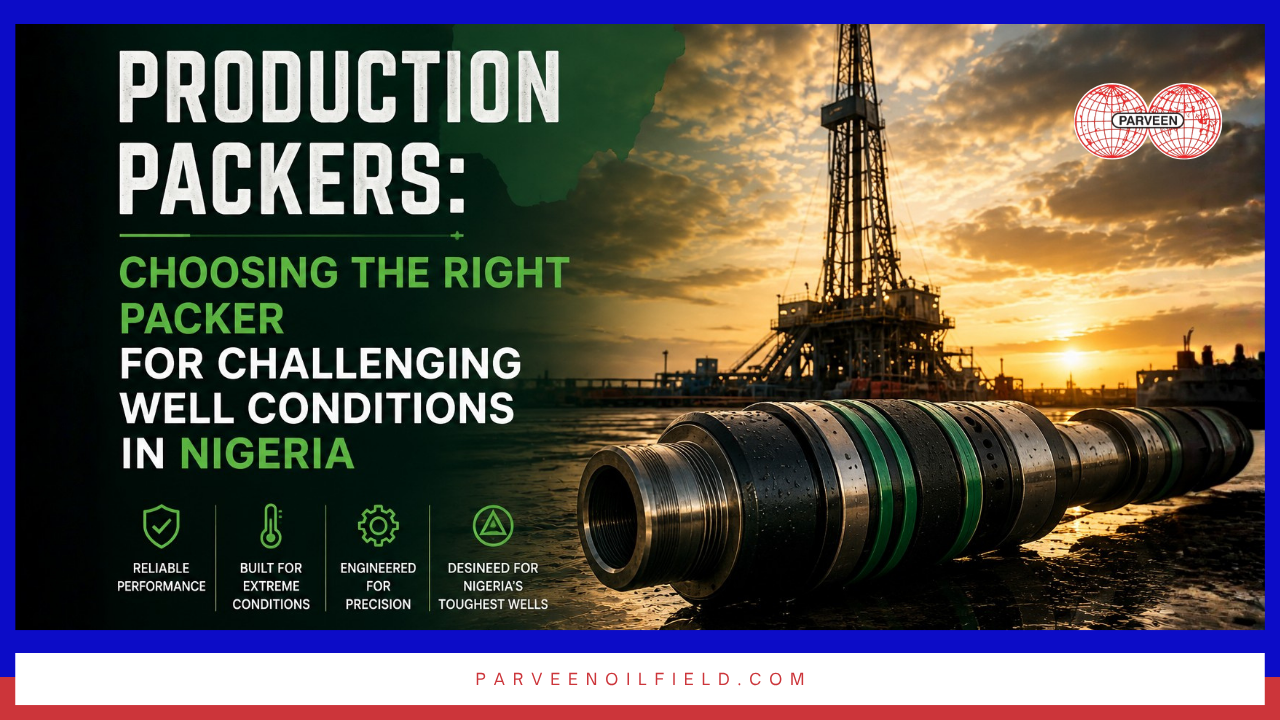
Why Packer Selection Is the Most Consequential Completion Decision in Nigerian Wells
The production packer is the downhole component that determines whether a Niger Delta well produces its targeted oil rate or becomes a water-flooded, sand-plugged problem asset. Set correctly in the right configuration with the right materials, a production packer isolates the producing interval from water-bearing zones, protects the casing from production fluids and pressures, and maintains zonal integrity across the well’s entire productive life without requiring intervention. Set incorrectly — wrong type, wrong elastomer, wrong setting mechanism for the wellbore deviation — it fails, loses zonal isolation, allows water breakthrough, and transforms a profitable production well into a workover candidate.
In Nigeria’s Niger Delta, the stakes of this decision are particularly high. The Agbada Formation’s poorly consolidated sandstones produce not just crude oil but also formation sand, reservoir pressure-decline water, CO₂-rich associated gas, and — in many wells — trace H₂S. These conditions subject the packer’s elastomeric sealing elements to chemical attack that standard-specification packers are not designed to resist. The result is premature seal failure, loss of zonal isolation, and water breakthrough that can occur within three to five years of completion in wells that should have maintained isolation for fifteen or twenty years.
Compounding this is Nigeria’s workover cost environment. A packer workover in the Niger Delta — requiring rig mobilization, security arrangements, crew logistics, and downtime on an asset that may be producing 2,000–5,000 bpd — costs between USD 500,000 and USD 3 million depending on well complexity. This cost structure means that the differential between a correctly specified packer (which maintains isolation throughout the well life) and a poorly specified packer (which requires a workover at year three to five) is measured in millions of dollars, not in the thousands that separate procurement options at the point of purchase.
This guide provides the technical framework to select the right production packer for Nigerian well conditions — covering type, setting mechanism, elastomer selection, API 11D1 compliance, and what genuine custom engineering capability looks like in a supplier.
The Primary Decision: Permanent or Retrievable?
The first and most fundamental packer selection decision is whether to use a permanent or retrievable design. This decision should be driven entirely by the operator’s workover plan for the well — not by upfront cost considerations.
Permanent Packers: Set in the casing string and removed only by milling — a well service operation that requires a workover rig and specialized mill-run tooling. Permanent packers can be set in any wellbore deviation, including horizontal wells, without the rotation or pick-up movement that mechanical-set retrievable packers require. They achieve the highest pressure and temperature ratings in the industry — benchmark permanent packers are rated to 20,000 PSI and 475°F [1] — and provide the most reliable long-term sealing integrity because the set condition is permanent and cannot be accidentally released by tubing movement. For Niger Delta completions where no workover is planned and the packer is expected to remain in place for the well’s entire producing life, a permanent hydraulic-set packer is the technically correct choice.
Retrievable Packers: Set and released by specific tubing manipulation or hydraulic pressure application, allowing the packer to be pulled out of hole during a workover without milling. Retrievable packers are used when the operator anticipates: re-entry into the producing zone for workover or restimulation; the need to change production configurations (e.g., convert a single-zone completion to a dual-zone); or temporary zone isolation during well service operations. The limitation of retrievable packers is their lower pressure and temperature rating relative to permanent designs — benchmark retrievable packers are rated to 15,000 PSI and 400°F [1] — and their susceptibility to accidental release if tubing loading conditions during production operations approach the packer’s release threshold. Parveen’s completion equipment range includes both retrievable and permanent designs configured for Nigerian well conditions.
For Nigerian indigenous operators managing acquired OML assets — where the workover history is unclear, the well completion record may be incomplete, and the production profile of individual zones may not be fully characterized — retrievable packers with a defined release mechanism provide the operational flexibility to access and recomplete the well as understanding of the asset improves.
Setting Mechanism: Mechanical vs Hydraulic
Having established whether a permanent or retrievable packer is required, the next decision is the setting mechanism:
Mechanical-Set Packers: Set by rotating and/or picking up or setting down the tubing string from the surface. The torque, tension, or compression applied to the tubing string actuates the packer’s setting mechanism, causing the slips to anchor to the casing and the element to expand and seal. Mechanical-set packers are appropriate for onshore wells and shallow offshore wells with depths below approximately 12,000 feet (3,658 metres), where accurate torque and weight transmission to the packer is achievable from surface. In highly deviated Nigerian wells, tubing rotation becomes unreliable at depth, making mechanical-set packers less suitable than hydraulic designs for deviated or horizontal completions [2].
Hydraulic-Set Packers: Set by applying hydraulic pressure through the tubing bore or through an annular hydraulic line. The hydraulic pressure acts on a piston within the packer body, driving the slips and element into the set position without requiring tubing rotation or manipulation. Hydraulic-set packers are the preferred design for Nigerian Niger Delta wells for several reasons: they are appropriate for any wellbore deviation including horizontal; they can be set at greater depths without the torque transmission limitations of mechanical-set designs; and the setting force is more consistent and controllable from surface. Parveen’s RHP-SPR and RHP-DB hydraulic-set retrievable packer designs are configured for Nigerian service, providing reliable set actuation across the range of Niger Delta wellbore conditions.
Elastomer Selection: The Decision That Determines Service Life
In Nigeria’s CO₂-rich, brine-bearing production environment, elastomeric seal compound selection is the single most important packer specification parameter for service life. The packer element is the sealing component — it expands against the casing wall to create the annular seal that isolates the producing zone. When the element material degrades, the seal degrades, and zonal isolation is lost.
The elastomeric performance hierarchy for Nigerian Niger Delta service conditions is as follows:
Nitrile Rubber (NBR) is the baseline element material and is adequate for wells producing sweet crude without significant CO₂ or H₂S exposure. It is rated to approximately 212°F (100°C) and provides reasonable resistance to hydrocarbon solvents in sweet crude service. NBR is not appropriate for Niger Delta wells with confirmed CO₂ in produced gas — which describes the majority of Niger Delta producing wells — because CO₂ degradation of NBR compounds begins within two to three years of service, accelerating toward complete seal failure as CO₂ concentration and temperature increase.
Hydrogenated Nitrile Butadiene Rubber (HNBR) provides substantially improved resistance to CO₂ degradation compared to standard NBR, is rated to approximately 302°F (150°C), and provides adequate H₂S resistance for the trace sour service typical of most Niger Delta wells. HNBR is Parveen’s standard recommendation for Nigerian packer service — it addresses the dominant elastomer failure mode in this environment (CO₂ degradation) at a moderate cost premium over NBR that is entirely justified by the service life extension it delivers.
Fluorocarbon (FKM, commercially known as Viton) and FFKM (perfluoroelastomer) compounds provide further escalation in temperature and chemical resistance, rated to 392°F and 446°F respectively [3], and are specified for the most severe combined high-temperature, sour service, and high-CO₂ environments. They are not typically required for standard Niger Delta production wells but are appropriate for deep gas wells with high bottomhole temperatures or elevated sour gas concentrations.
The practical implication: every packer purchase order for a Nigerian well should specify the elastomer compound explicitly — not simply “standard element” or “as per manufacturer standard.” Buyers should provide the well fluid analysis (CO₂ percentage, H₂S concentration, produced water chloride content) and bottom-hole temperature to the manufacturer, who should then specify and document the appropriate compound.
API 11D1 Compliance and Validation Grades: What They Mean for Nigerian Buyers
API 11D1 (and its equivalent ISO 14310) is the standard governing the design qualification, testing, and manufacturing of production packers. Understanding its validation grade system is important for Nigerian procurement teams:
API 11D1 defines validation grades from V6 (minimum) through V0 (highest). The grade determines the rigor of the qualification testing the packer design must undergo before it can be marked as API 11D1 compliant [2]. V3 is the minimum grade appropriate for most liquid-service Nigerian production wells, confirming that the design has been tested under temperature cycle conditions simulating the well’s thermal profile. V0 is the gas-tight grade — tested with gas medium at rated pressure with zero permissible leakage — and is required for gas-producing wells or wells with a gas-bearing zone above the packer where a gas-tight seal is critical [4].
Nigerian buyers should require that any packer quoted for their wells carries an API 11D1 compliance declaration specifying the validation grade achieved by the packer design qualification test. A packer that is “designed to API 11D1” without a documented validation grade has not been formally qualified and cannot be represented as API 11D1 compliant. This distinction matters significantly when NUPRC’s well integrity requirements are evaluated during regulatory inspection.
 Parveen Industries: Custom-Engineered Production Packers for Nigerian Well Conditions
Parveen Industries manufactures production packers for Nigerian service to API 11D1 in configurations covering the full range of Niger Delta well conditions. Parveen’s capability extends beyond catalogue supply to genuine custom engineering for unusual well configurations — non-standard casing weights, extreme deviation profiles, unusual fluid compositions, or well architectures that require modified setting mechanism design.
Parveen’s production packer range for Nigerian service includes hydraulic-set retrievable packers in HNBR element standard (with AFLAS or FFKM available for elevated temperature or severe sour service), permanent hydraulic-set designs for long-life single-setting completions, and service packers for temporary isolation during workover, squeeze cementing, or acidizing programs. Cement retainers and bridge plugs complement the packer range for zone abandonment and remedial cementing programs.
For Nigerian indigenous operators managing multi-OML portfolios with varying well conditions across their asset base, Parveen provides application engineering support that reviews each well’s pressure, temperature, deviation, and fluid composition data before specifying the packer — ensuring that the equipment delivered is correctly engineered for the well it will be installed in, not selected from a catalogue on the basis of nominal casing size alone.
Frequently Asked Questions (FAQs)
Q1. What is the most common cause of production packer failure in Niger Delta wells, and how does Parveen address it? The most common cause of production packer failure in Niger Delta wells is elastomeric element degradation caused by CO₂ exposure in produced water and gas. Standard nitrile rubber (NBR) elements degrade through CO₂-induced plasticizer extraction and polymer network breakdown, losing sealing contact with the casing wall over a period of three to five years in typical Niger Delta produced water conditions. Parveen addresses this by specifying HNBR element compounds as standard for all Nigerian packer supply, with formal written confirmation of the compound selection and its temperature/CO₂ service rating provided as part of the packer’s documentation package.
Q2. How does Parveen confirm that a retrievable packer can be set and released in a deviated Niger Delta well? Parveen’s application engineers review the wellbore deviation survey and the planned completion depth before specifying the packer setting mechanism. For wells with inclinations above 30–35 degrees from vertical — where tubing rotation becomes unreliable — hydraulic-set packer designs are specified in preference to mechanical-set designs. The hydraulic setting mechanism functions reliably at any deviation from vertical, including horizontal completions. For extreme deviated completions, Parveen can modify the hydraulic setting piston design to ensure setting force adequacy at the planned setting depth and deviation.
Q3. What API 11D1 validation grade does Parveen’s production packer range carry, and why does it matter? Parveen manufactures production packers to API 11D1 with validation grades appropriate for the service application — V3 minimum for liquid-service Nigerian wells, and V0 (gas-tight) for wells with gas-bearing zones where a gas-tight annular seal is required. The validation grade is documented in the packer’s design qualification record, which Parveen provides as part of the API 11D1 compliance documentation package. The validation grade matters for Nigerian buyers because NUPRC’s well integrity requirements reference API 11D1 compliance as evidence that downhole equipment meets performance qualification standards — and only a documented validation grade constitutes formal API 11D1 compliance.
Q4. Can Parveen supply packers for non-standard casing programs in Nigerian wells where API standard casing sizes are not used? Yes. Parveen’s custom engineering capability covers non-standard casing OD and weight combinations that fall outside the API 5CT standard casing size range commonly stocked by other manufacturers. For Nigerian wells where the casing program was designed or modified for well-specific reasons — including older wells completed before API standard casing was universally adopted — Parveen can manufacture slip and element assemblies sized for the actual inside diameter of the non-standard casing, confirmed from the operator’s casing specification or internal diameter calliper log.
Q5. What documentation does Parveen provide with production packers for Nigerian wells under NUPRC oversight? Parveen’s production packer documentation package for Nigerian service includes: API 11D1 compliance declaration specifying the validation grade; material test reports (MTRs) traceable to original heat numbers for all metallic components; elastomer compound specification with temperature and service rating confirmation; dimensional inspection records for all critical dimensions; hydrostatic function test record at rated working pressure; and elastomeric element material certificate confirming compound designation and supplier. This package is structured to support NUPRC regulatory file requirements and can be submitted with the well completion record at the conclusion of the completion program.
Q6. Does Parveen supply service packers for workover operations on Nigerian wells in addition to permanent and retrievable production packers? Yes. Parveen’s service packer range covers temporary isolation applications during workover programs — squeeze cementing through a cement retainer, acidizing isolation, water shutoff squeezes, and production testing isolation. Service packers from Parveen are available in mechanical-set and hydraulic-set designs suitable for workover by wireline or coiled tubing intervention, providing a cost-effective temporary isolation solution that does not require a full workover rig mobilization for each service operation.
Call to Action
In Nigeria’s Niger Delta, the right packer specification is the difference between a twenty-year producing well and a three-year workover candidate. Parveen Industries combines API 11D1 manufacturing with genuine application engineering — reviewing each well’s conditions before specifying equipment, not after.
Contact Parveen Industries Nigeria to submit your well specifications for packer application engineering review. The first step is a technical review; the second step is the right packer for your well.
📧 Visit parveenoilfield.com/ng/ to request a packer specification consultation or download Parveen’s production packer datasheet.
Parveen Industries — API 11D1-Compliant. Custom-Engineered. Niger Delta–Ready.
Data Sources & References
[1] The benchmark pressure and temperature ratings for permanent packers (20,000 PSI at 475°F) and retrievable packers (15,000 PSI at 400°F), attributed to Halliburton’s production packer specifications (permanent packers manufactured for over 75 years; retrievable packers rated to stated parameters), are drawn from Maximus OIGA’s Well Completion Equipment complete guide and the Oil Well Packer types, components and working guide published June 30, 2026 (https://midwestindustries.org/blog/oil-well-packer/; https://maximusoiga.com/insights/well-completion-equipment-complete-guide-to-tools-selection-manufacturers).
[2] The API 11D1 validation grade system from V6 to V0, the guidance that shallow wells favour mechanical-set packers while deep wells beyond approximately 12,000 ft favour hydraulic or permanent designs, and the selection framework based on pressure, temperature, deviation, and re-entry planning, are from Maximus OIGA’s Types of Packers in Well Completion: Selection Guide 2026 (https://maximusoiga.com/insights/types-of-packers-in-well-completion-complete-selection-guide-for-engineers) and the Packer in Well Completion — Functions, Types and Selection guide (https://maximusoiga.com/insights/packer-in-well-completion-functions-types-selection).
[3] The elastomeric seal compound performance hierarchy — NBR (< 212°F), HNBR (< 302°F), FKM (< 392°F), FFKM (< 446°F+) — and the recommendation to match elastomer to actual well temperature and fluid composition before specifying, are from the HPHT Completion Equipment 2026 Engineer’s Selection Guide (https://maximusoiga.com/insights/hpht-completion-equipment) and the Types of Packers selection guide (https://maximusoiga.com/insights/types-of-packers-in-well-completion-complete-selection-guide-for-engineers).
[4] The API 11D1 / ISO 14310 validation grade requirement that V0 be applied for gas-tight packer service (tested with gas medium, zero permissible leakage), and the minimum 15-20% safety margin recommended for packer pressure and temperature rating over the well’s expected conditions, are referenced in the Retrievable Packer Oil Well 2026 selection guide (https://www.accio.com/plp/retrievable-packer-oil-well) and confirmed in API 11D1 standard documentation descriptions across Maximus OIGA’s packer reference library.