
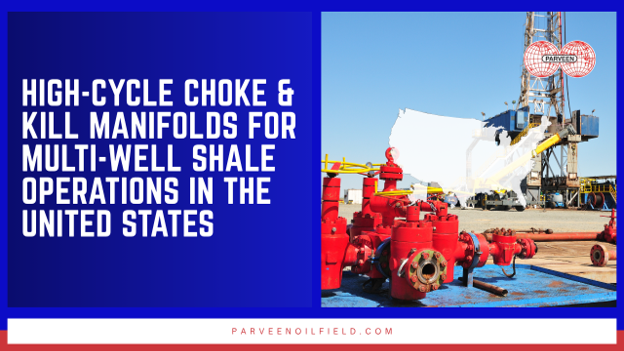
Executive Summary: U.S. Shale’s Productivity Revolution Demands Engineering Precision
The United States shale industry has achieved what few thought possible a decade ago: record oil and gas production with fewer drilling rigs than the peak years of 2014. Total U.S. crude oil output averaged approximately 13 million barrels per day in 2024, with BloombergNEF projecting a further 4.5% increase to a record 13.9 MMbpd in 2025 [1]. The EIA’s own concurrent estimate was 13.7 MMbpd, underscoring broad consensus around record-breaking U.S. shale productivity [1].
This efficiency revolution has a direct consequence for pressure control equipment. Shale wells drilled in 2024 demonstrated a 15% productivity improvement over the prior year, driven by extended lateral lengths, optimized hydraulic fracturing, and increasingly sophisticated multi-well pad execution [2]. Multi-well pads create repeated, high-intensity pressure cycles across shared manifold infrastructure. Where a conventional single-well program might cycle a choke and kill manifold through controlled pressure events relatively infrequently, a 10-well Permian pad—with simultaneous fracturing operations, staggered well completions, and sequential flowbacks—subjects manifold bodies, valve seats, and connecting iron to fatigue profiles that demand purpose-built engineering. Parveen Industries’ custom-manufactured choke and kill manifold systems are built for exactly these demands.
The U.S. Upstream Context: Multi-Well Pads and the Pressure Control Imperative
Production Scale: In 2024, over 918,000 U.S. oil and gas wells were in production [3]. The Permian Basin alone accounts for approximately 46% of total U.S. tight oil production. Multi-well pad drilling—the dominant completion strategy in all major shale plays—concentrates multiple wells onto a single surface location, with 6, 8, 10 or even 12+ wells sharing infrastructure.
Shale Gas Production Scale: Shale gas and tight oil production reached 29.4 trillion cubic feet in 2024 [4], with forecasts projecting further growth to more than 35 trillion cubic feet by 2050. The North American market segment continues to drive the largest growth share in multi-well pad drilling technology globally [5].
Multi-Well Pad Technology Market: The global multi-well pad drilling technology market was projected to surpass USD 180 billion by 2024, driven by accelerating adoption across North American shale plays [5]. Extended-reach laterals and enhanced hydraulic fracturing methods are becoming standard practice, with predictive maintenance systems deployed across major operators to minimize downtime [2].
Pressure Profile Complexity: Extended lateral wells (now routinely exceeding 15,000 feet) encounter variable formation pressures across their length. Fracturing operations routinely involve surface treating pressures of 7,000–15,000 PSI. Flowback management requires the ability to precisely control wellhead pressure during the high-velocity initial production period—a task delegated entirely to the choke manifold system.
Well Control Context: The U.S. has 918,000+ producing wells across more than 100,000 active wellbores in shale plays at any given time [3]. Well control incidents carry multimillion-dollar consequence costs and regulatory implications under BSEE/BOEMRE and state-level commission rules. Choke & kill manifolds are the primary engineered response system at surface when well control events occur.
Coil Tubing Operations: The growth of coil tubing-based stimulation, plug mill-out, and workover operations in shale plays adds another pressure cycling demand to manifold and wellhead systems. Coil tubing equipment interfaces—including coil tubing pressure control equipment—must be rated, tested, and compatible with the wellhead system’s existing pressure rating.
Engineering Deep Dive: What Makes a Choke & Kill Manifold Fail in High-Cycle Shale Service?
Understanding failure modes is the foundation of specifying the right equipment. In multi-well shale operations, manifold degradation typically occurs through:
- Erosive Wear on Choke Internals: High-velocity flowback fluid carrying sand proppant is abrasive. Adjustable chokes with conventional trim materials can erode rapidly during early flowback, compromising pressure control precision and increasing replacement frequency. Carbide-tipped or tungsten carbide trim dramatically extends service life.
- Fatigue Cracking in Manifold Bodies: Repeated pressure cycling from 0 to working pressure (and pressure cycling during simultaneous fracturing operations on adjacent wells) induces cyclic stress in manifold body forgings and welds. Equipment not specifically designed and tested for high-cycle service is vulnerable to fatigue cracking over operational timescales well within the pad’s producing life.
- Valve Seat Leakage: API 6A gate valves serving as isolation valves in manifold systems are subjected to repeated full-bore pressure differentials. Seat leakage—even minor—creates a pressure management problem during well interventions and a potential safety hazard during kill operations. Parveen’s gate valve seat designs specify controlled face-to-face tolerances and elastomeric seal materials rated for the fluid composition and temperature range of the target formation.
- Connection Failures: High-pressure iron connections (unions, swivel joints, treating iron) in manifold hook-up lines are subjected to both pressure and mechanical loading during high-rate frac operations. Oil and gas unions equipment, swivel joints, and treating iron must be API 6A/16C rated and visually inspected before each frac stage.
Parveen Industries: API-Engineered Pressure Control for U.S. Shale
Parveen Industries manufactures a comprehensive range of pressure control equipment and manifold systems for U.S. upstream operators, engineered to API 16C (choke and kill equipment), API 6A (wellhead and wellsite equipment), and API 6D (valves) specifications.
Choke & Kill Manifolds Parveen’s choke and kill manifolds are available in 3,000 to 15,000 PSI WP ratings, with configurations from single-choke to full dual-choke/dual-kill arrangements. Key engineering features include:
- Forged high-strength steel bodies with full NDE (ultrasonic and magnetic particle testing)
- Adjustable chokes with tungsten carbide trim for sand-laden shale flowback
- API 6A gate valves on all isolation positions, rated to PSL 2 minimum
- Accumulator bottle provisions for hydraulic closing of safety-critical valves
- Custom skid-mounted configurations with pre-assembled and pressure-tested pipework
HFP Plug Valves High-frequency plug valves from Parveen are designed for repeated on/off cycling in frac tree and manifold service. Their quarter-turn actuation, metal-to-metal sealing surface, and sealant injection provision make them particularly suited to the high-cycle demands of multi-well pad frac operations.
Wellhead and Xmas Tree Equipment For operators standardizing wellhead configurations across pad drilling programs, Parveen offers unitized wellheads and modular Christmas tree components in standardized pressure classes, enabling inventory rationalization and faster installation turnaround between wells.
Treating Iron and High-Pressure Flow Lines Parveen’s treating iron oil and gas products—including straight and curved sections, crosses, tees, and elbows—are manufactured to API 6A/7-2 specifications in working pressures up to 20,000 PSI, with full compliance documentation for U.S. operator QA requirements.
Coil Tubing Pressure Control Equipment With coil tubing operations growing in shale plays for plug mill-out, stimulation, and sand cleanout, Parveen’s coil tubing equipment portfolio covers the BOPs, stripper rubber assemblies, and flow tees required for safe coil tubing pressure control at the wellhead.
Equipment Relevance: Case Illustration — 10-Well Permian Pad Program
Scenario: A mid-size Permian Basin operator executing a 10-well, staggered pad development program requires a shared choke and kill manifold system capable of supporting simultaneous fracturing operations on two wells at 10,000 PSI WP, with the ability to route flowback from any combination of producing wells through a central manifold during the early production period.
Challenges:
- Sand-laden flowback fluids cause rapid erosion of standard choke trim
- Simultaneous fracturing operations create complex pressure interference patterns in manifold connecting lines
- Equipment must be pre-configured for rig-site installation by completion crews unfamiliar with custom manifold layouts
- Full API 16C documentation required for operator’s engineering files and insurance compliance
Parveen’s Solution:
- Custom-engineered dual-choke, dual-kill manifold in 10,000 PSI WP with a multi-well inlet header incorporating swivel joints and API 6A gate valves on each well branch
- Tungsten carbide adjustable chokes on both choke positions for extended erosion resistance
- Pre-tested, color-coded, and labeled factory assembly with dimensional drawings aligned to the operator’s P&ID
- Complete API 16C documentation package including material traceability, hydrostatic test records, and dimensional inspection reports
U.S. shale production is setting records, and so are the pressure demands on your manifold systems. Don’t let equipment failures or premature erosion create costly interventions on your most productive pads.
Request a technical consultation with Parveen Industries to discuss choke and kill manifold specifications for your next U.S. shale pad program.
Visit parveenoilfield.com to submit your equipment inquiry, download product specifications, or connect with Parveen’s U.S. market application team.
Parveen Industries — API 16C & 6A Certified. Custom-Engineered. Shale-Ready.
Frequently Asked Questions (FAQs)
Q1. Do Parveen Industries’ choke and kill manifolds comply with API 16C for U.S. operations? Yes. Parveen’s choke and kill manifold systems are manufactured in accordance with API Spec 16C, which governs the design, material, testing, and documentation requirements for choke and kill equipment used in well control operations. All manifolds are accompanied by a full API 16C compliance documentation package, which U.S. operators can use to satisfy their engineering and regulatory file requirements.
Q2. Can Parveen supply choke manifolds with tungsten carbide trim for high-sand Permian Basin applications? Yes. Tungsten carbide trim is a standard offering in Parveen’s adjustable choke product line and is strongly recommended for shale applications where proppant-laden flowback fluids cause accelerated erosion of conventional trim materials. Choke trim material selection is part of Parveen’s application engineering scope and is determined based on the operator’s reported fluid composition, flow rate, and expected sand concentration.
Q3. What are the standard lead times and can Parveen support urgent equipment needs for U.S. operators? Standard configured choke and kill manifolds typically carry a 12–16 week manufacturing lead time from confirmed order. For U.S. operators with urgent requirements—particularly where a pad program’s schedule has been accelerated—Parveen can assess its current manufacturing queue and discuss expediting options. Parveen maintains strategic finished goods inventory of gate valves, adjustable chokes, and treating iron components that can reduce manifold assembly lead times significantly.
Q4. How are Parveen’s products imported and cleared for use in the United States? Parveen’s oilfield equipment exports to U.S. customers are handled through established freight and customs clearance channels. Equipment is supplied with all required API documentation, material certifications, dimensional reports, and hydrostatic test certificates that U.S. customs authorities and operator QA teams require. Parveen has an established export track record and can provide references from U.S.-based customers upon request.
Q5. Can Parveen customize manifold configurations to match our existing wellhead and tree pressure ratings? Yes. Customization to match existing wellhead pressure classes, nominal bore specifications, and connection standards (flanged or hammer union) is a core part of Parveen’s product engineering capability. Parveen’s application engineers work from the operator’s wellhead datasheet and completion design to configure a manifold that integrates directly with the installed wellhead system—eliminating the need for field adaptation or additional connection components.
Q6. Does Parveen supply other well control and surface equipment beyond choke and kill manifolds? Yes. Parveen’s U.S.-focused product portfolio also includes surface safety valves, wellhead and xmas tree assemblies, HFP plug valves, treating iron, swivel joints, and high-pressure unions for frac and completion operations. Consolidating equipment supply with a single API-qualified vendor simplifies your QA and procurement processes.
Data Sources & References
# Citation Source URL
[1] “Shale producers are pumping more oil per dollar invested … The U.S. will increase production 4.5% to a record 13.9 MMbpd next year. BNEF’s forecast is more bullish than the 13.7 MMbpd estimated by the U.S. Energy Information Administration.”
World Oil — U.S. shale oil production to break record in 2025 on drilling efficiencies (August 22, 2024)
https://www.worldoil.com/news/2024/8/22/u-s-shale-oil-production-to-break-record-in-2025-on-drilling-efficiencies/
[2] “According to data from the U.S. Energy Information Administration (EIA), shale wells drilled in 2024 already showed a 15% improvement in productivity compared to the previous year … new technologies like predictive maintenance systems are helping operators minimize downtime.”
DW Energy Group — U.S. Shale Production Trends to Watch in 2025 (January 20, 2025)
[3] “In 2024, 78% of the more than 918,000 U.S. wells produced 15 BOE/d or less, and 8% of the wells produced more than 100 BOE/d.”
U.S. Energy Information Administration — The Distribution of U.S. Oil and Natural Gas Wells by Production Rate (2025 Report, based on November 2025 data)
https://www.eia.gov/petroleum/wells/pdf/WDR2025_Full%20Report.pdf
[4] “Shale gas and tight oil production in the United States … 29.4 trillion cubic feet in 2024 … forecast to increase to more than 35 trillion cubic feet by 2050.”
Statista / U.S. EIA — Shale gas and tight oil plays production in the U.S. 2000–2050 (April 15, 2025)
https://www.statista.com/statistics/183740/shale-gas-production-in-the-united-states-since-1999/
[5] “The market for multi-well pad drilling technology is expected to surpass US$180 billion by 2024 … Analysts expect to see the most growth in the North American onshore market segment due to the large number of shale exploration and production projects.”
Investing News Network — Multi-Well Pad Drilling Technology and North America’s Shale Oil Boom (cited Global Market Insights report)
https://investingnews.com/daily/resource-investing/energy-investing/oil-and-gas-investing/multi-well-pad-drilling-technology-and-improving-north-americas-drilling-efficiency-and-shale-oil-boom/