
Executive Summary
Saudi Arabia operates the world’s largest single oil and gas production system, with Saudi Aramco maintaining a production capacity above 12 million barrels of oil per day while simultaneously executing the most ambitious gas expansion programme in the Kingdom’s history [1]. The Jafurah unconventional gas field, Aramco’s flagship domestic gas development, holds an estimated 229 trillion cubic feet of gas in place and is on course to produce 2 billion standard cubic feet per day of sales gas by 2030, with the Kingdom targeting a broader domestic gas production rate of 16 billion standard cubic feet per day [2]. Alongside Jafurah, conventional sour gas developments at Fadhili and Tanajib, tight gas production in the Khuff and Jilh formations, and sustained deep carbonate oil production across the main Ghawar trend all require wellhead equipment rated for extreme pressure and corrosive service conditions.
Choke valves are among the most mechanically demanding components in the wellhead and production flowline. Installed downstream of the Christmas tree wing valves, chokes throttle production flow from the reservoir to surface and must withstand sustained high differential pressure, continuous erosive wear from sand and liquid droplets in the flowing stream, and in KSA’s sour gas fields, hydrogen sulphide exposure that attacks metallic and elastomeric valve components. Selecting the wrong choke type or specification for a Saudi Arabian well, whether an adjustable choke, a positive choke, or an external sleeve design, creates a maintenance liability and an operational risk.
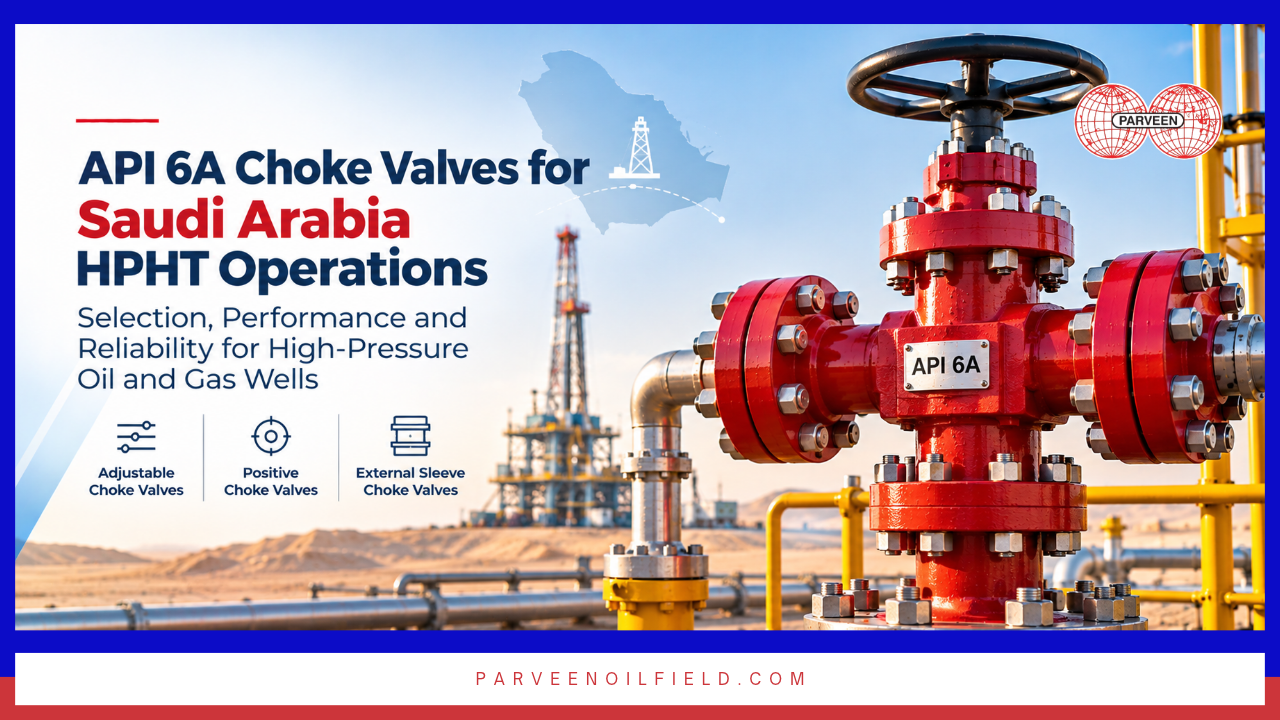
Parveen Industries manufactures API-Compliant choke valves designed to API Specification 6A (21st Edition), covering adjustable choke valves (H2 type), external sleeve control chokes, positive choke valves, and hydraulic drilling chokes. With supply experience to Middle East oil and gas operators, Parveen provides choke valve options for the full range of wellhead pressure classes encountered in Saudi Arabian production.
This article covers the engineering of API 6A choke valve types, the specific selection considerations for Saudi Arabia’s HPHT and sour-gas wells, erosion resistance requirements, and the product options available from Parveen Industries.
Choke Valve Types Under API 6A: Definitions and Operating Principles
API Specification 6A defines choke valves as a category of wellhead and tree equipment and governs their design, pressure rating, temperature rating, material specification, and testing requirements in the same framework as gate valves, casing heads, and other wellhead components [3]. Under this framework, three principal choke valve architectures are in common use in Saudi Arabian production: adjustable chokes, positive chokes, and external sleeve control chokes.
Adjustable Choke Valves
An adjustable choke valve uses a rotating needle-and-seat (or needle-in-cage) mechanism to vary the flow area through the valve. As the needle is rotated, it advances or retracts against the seat orifice, increasing or decreasing the flow passage diameter and thus the flow restriction. This variable-orifice design allows operators to set production rate by adjusting the choke position without shutting in the well, providing continuous production rate control.
Adjustable chokes are essential in production management contexts where the flowrate must be actively managed to protect downhole reservoir conditions, maintain pipeline pressures, or meet daily production allocation targets. For Saudi Aramco’s large multi-well production programmes, adjustable chokes on individual wellheads allow each well’s contribution to a commingled production gathering system to be tuned against field-wide targets. The H2 type, which Parveen Industries manufactures, is a standard industry design with a replaceable bean or seat liner in tungsten carbide or ceramic for erosion resistance in abrasive service.
Positive Choke Valves
A positive choke valve uses a fixed orifice insert (a bean) with a precisely drilled bore of defined diameter. The choke size is selected based on the anticipated production rate and reservoir pressure, and the fixed orifice produces a consistent pressure drop and flow rate for a given wellhead pressure. Changing the production rate requires physically replacing the bean with one of a different bore diameter, which requires shutting in the well and opening the choke body.
Positive chokes are preferred in applications where flow rate stability and metering accuracy are more important than flexibility. They are simpler mechanically than adjustable chokes, with fewer moving parts and lower maintenance burden. For Saudi Arabian wells with established, stable production rates in mature oil fields, positive chokes are frequently used. They are also preferred in test separator configurations where the fixed orifice provides a known flow restriction that simplifies well testing and allocation calculations.
External Sleeve Control Chokes
The external sleeve control choke uses a sliding outer sleeve over a fixed inner body with flow ports. As the sleeve is repositioned axially by rotating a hand-wheel or actuator, it progressively covers or uncovers the ports, varying the flow area in a linear or near-linear manner. This design offers the progressive control of an adjustable choke with a different wear pattern: erosion is distributed across the sleeve edge and port margins rather than concentrating on a needle tip and seat bore.
External sleeve chokes are common in applications with moderate sand or produced solids content, where the distributed wear pattern of the sleeve design extends the service life of wetted components compared to a needle-and-seat design under the same abrasive flow conditions. For some KSA gas condensate fields with incipient sand production in the later producing life, external sleeve designs are considered for their superior erosion profile.
Hydraulic Drilling Choke
A hydraulic drilling choke is specifically designed for use in the choke manifold during well control operations. It is not a production choke; it is used to impose controlled back-pressure on the wellbore during a kick-containment operation (kill-weight mud pumping, volumetric well control) and must respond to rapid remote adjustment by the driller or well control engineer at the choke control panel. API 6A governs its body design and pressure rating; API 16C governs choke and kill manifold configurations.
HPHT Selection Criteria for Saudi Arabian Well Conditions
Saudi Arabia’s oil and gas fields span a wide range of wellhead pressure conditions. Conventional carbonate oil producers in the Arab-D formation of the Ghawar field operate at moderate wellhead pressures of 2,000 to 3,000 psi. Tight gas wells in the Khuff formation and deep unconventional gas developments in the Jafurah Basin encounter much higher reservoir pressures, with some Khuff wells producing against 10,000 psi wellhead pressure and Jafurah wells targeting reservoirs at depths exceeding 4,000 metres with high formation pressures [2].
For choke valves serving Saudi HPHT applications, the following selection criteria are determinative.
Pressure Class
API 6A pressure classes relevant to Saudi Arabian production range from 5,000 psi for moderate-pressure gas wells to 15,000 psi and above for deep HPHT formations. The choke valve’s rated working pressure must equal or exceed the maximum anticipated shut-in wellhead pressure (SIWHP) for the well. Positive chokes in fixed-bean configurations are available up to 15,000 psi rated working pressure in standard API 6A dimensions; adjustable chokes at high pressure classes may require external actuators or override mechanisms to handle the high differential force on the needle stem.
Sour Service (H2S) Compliance
A substantial proportion of Saudi Arabia’s gas production comes from sour reservoirs containing hydrogen sulphide. The Khuff and Arab formations, the primary gas-bearing zones in the Kingdom, produce H2S concentrations that require NACE MR0175 / ISO 15156 compliance across all wetted choke components. This means body material hardness must be maintained below the NACE HRC 22 limit, elastomeric seal materials must be evaluated and qualified for H2S compatibility, and the full valve including stem, seat, and trim must be of NACE-qualified grade.
Choke valves for H2S service are ordered with explicit sour-service designation (Material Class FF under API 6A, combined with PSL 3 or PSL 4 for higher criticality applications). Procurement teams should request the NACE compliance documentation as part of the valve delivery package rather than relying on a general “API 6A-compliant” claim.
Erosion Resistance and Trim Selection
Gas wells in Saudi Arabia, particularly tight-gas and unconventional producers in Jafurah and the northern gas fields, produce at high velocity and with varying levels of formation sand or proppant flowback. High-velocity flow through a choke orifice creates localised erosion at the seat and needle tip or bean bore, progressively enlarging the orifice over time and causing production rate drift. For abrasive service, choke internal trim, the components in the flow path, should be specified in hard materials.
Tungsten carbide inserts for the seat and bean are the standard erosion-resistant specification for abrasive Saudi Arabian choke service. Ceramic trim (silicon carbide or alumina ceramic) is used in the most severely erosive conditions but is more brittle and less tolerant of solid impingement at high angles. For H2S-containing wells, trim material selection must also meet the hardness limits imposed by NACE MR0175, which restricts the use of some hard alloys in sour service.
Temperature Class
Reservoir temperatures in Saudi Arabia’s deeper formations can be significant. The Jafurah Basin, targeting depths of 2,500 to 4,500 metres, encounters bottomhole temperatures that may translate to elevated surface temperatures in HPHT wells with minimal wellbore heat loss. The API 6A temperature classification system assigns service temperature ranges to letter codes (Class P, R, S, T, U, V). For most Saudi Arabian surface wellhead service, Class T (ambient to 180°F / 82°C) or Class U (ambient to 250°F / 121°C) is appropriate. For HPHT wells with elevated surface conditions, Class V (up to 350°F / 177°C) choke valve specification may be required.
Choke Manifold Configuration for Saudi Arabian Production
A choke manifold is an assembly of chokes, valves, and piping that directs flow from one or more wells through the production choke to a gathering system or separator, with provision for bypass and kill-side access. In Saudi Arabian operations, choke manifolds are typically part of a wellhead pad surface package, integrated with the production flowlines and test separator connections.
Under API 6A, the choke manifold’s body components, flanges, and connections must be rated to the wellhead working pressure. The configuration typically includes upstream isolation valves, the choke itself (adjustable or positive), downstream pressure gauges, and bypass valving for well test switching and choke change-outs without full well shut-in. Parveen Industries supplies complete choke and kill manifolds designed to this configuration [4].
For drilling operations, the choke and kill manifold is a separate item governed primarily by API 16C, with the hydraulic drilling choke as the active control element during well control operations. The PHDC-01 hydraulic drilling choke from Parveen Industries is designed for this service, with remote hydraulic actuation from the driller’s choke control panel.
Parveen Industries’ Choke Valve Products for Saudi Arabian Operations
Parveen Industries manufactures and supplies a comprehensive range of API-Compliant choke valves for Saudi Arabian wellhead and production applications, covering all three principal choke types plus hydraulic drilling choke service.
Adjustable Choke Valve (H2 Type): The Parveen H2 adjustable choke valve uses a rotating needle-in-seat design with a replaceable tungsten carbide or ceramic seat insert for erosion resistance in gas and gas condensate service. It is available in pressure classes from 5,000 psi through 15,000 psi working pressure, with sour-service material options for KSA H2S-bearing formations. The needle position indicator provides a visual read of choke opening percentage at the wellhead. The H2 is suited to Saudi Arabian gas wells, gas condensate producers, and high-GOR oil wells requiring continuous production rate adjustment.
External Sleeve Control Choke: Parveen’s external sleeve choke uses a sliding sleeve over a ported body, with progressive flow area control as the sleeve is repositioned. The design distributes erosive wear over the sleeve edge and port perimeter, extending component life in moderately abrasive service compared to a needle-tip design under equivalent conditions. Available in pressure classes to 10,000 psi working pressure, this choke is suited to Saudi Arabian fields with produced sand content and to operators who prefer the sleeve choke’s simpler seat geometry for field maintenance.
Positive Choke Valve: The Parveen positive choke valve uses a fixed-bore bean insert in tungsten carbide or ceramic, available in a range of standard orifice sizes for production rate selection at commissioning. The body is available in pressure classes from 2,000 psi through 10,000 psi. This design is suited to stable Saudi Arabian oil producers in the Ghawar and other mature carbonate fields where production rates are established and bean-change flexibility is not required during normal operations.
PHDC-01 Hydraulic Drilling Choke: The Parveen PHDC-01 is a remotely actuated hydraulic drilling choke designed for choke manifold installation during well control operations. It is hydraulically actuated with adjustable position control from the driller’s panel, allowing the driller to impose controlled back-pressure on the wellbore while circulating out a kick. The PHDC-01 is rated for the working pressure class of the well programme and includes position feedback for driller confirmation of choke status.
Choke and Kill Manifold: Parveen supplies complete choke and kill manifolds for Saudi Arabian drilling programmes, integrating choke valves, gate valves, pressure gauges, and piping in a skid-mounted assembly configured to the well programme’s pressure class. Both standard API 16C drilling choke manifolds and production choke manifold configurations are available.
The full Parveen choke valve and pressure control product range is at the wellhead and choke product category and all products page.
Case Illustration: Choke Selection for a Jafurah Unconventional Gas Well
A production engineer is specifying wellhead choke equipment for a Jafurah tight gas well targeting the Jafurah Clastics formation at approximately 3,500 metres depth. The reservoir pressure is estimated at 8,500 psi, and the anticipated shut-in wellhead pressure after reservoir depletion allows for is approximately 7,200 psi. The formation fluid contains 0.08 percent H2S mole fraction, placing the well in sour-gas service under NACE criteria. Some sand flowback is anticipated in the first months of production given the hydraulic fracturing programme planned for the well.
The engineer’s choke specification calls for: 10,000 psi working pressure (above the SIWHP with margin); Material Class FF, PSL 3, NACE MR0175 / ISO 15156 compliant; tungsten carbide seat and needle trim rated for abrasive service; adjustable type to allow continuous rate management against Jafurah gathering system pressures.
A Parveen H2 adjustable choke valve, configured to 10,000 psi working pressure, Material Class FF, PSL 3, with tungsten carbide seat and replaceable needle tip, satisfies this specification. The choke is installed on the production wing of the Christmas tree with an upstream isolation gate valve and downstream pressure monitoring connection. During the initial flowback and clean-up period, the engineer adjusts the choke from a 1/4-inch bean equivalent opening to progressively larger openings as the well cleans up, managing the flowrate and wellhead pressure against the gathering system without shutting in the well.
After six months of production, inspection shows controlled, predictable erosion on the tungsten carbide seat at the needle contact face. The seat insert is replaced during a planned wellhead service, restoring the choke to its original orifice geometry at a fraction of the cost of full choke body replacement.
Frequently Asked Questions
Q1: What is the difference between an adjustable choke valve and a positive choke valve in API 6A wellhead service?
An adjustable choke valve uses a rotating needle-in-seat mechanism to vary the flow area continuously, allowing production rate to be changed without shutting in the well. A positive choke valve uses a fixed-bore bean insert that must be physically replaced to change the flow restriction. Adjustable chokes offer operational flexibility but have more moving parts and require more maintenance. Positive chokes are simpler, more accurate for flow metering at a fixed condition, and have fewer failure modes but require a well shut-in to change the flow setting. Both types are covered by API 6A and both are available from Parveen Industries in configurations suitable for Saudi Arabian wellhead service.
Q2: How does API 6A pressure class selection work for choke valves in Saudi HPHT wells?
API 6A defines six standard pressure classes for wellhead equipment: 2,000, 3,000, 5,000, 10,000, 15,000, and 20,000 psi. For choke valve service in Saudi Arabia, the pressure class is selected to equal or exceed the maximum anticipated shut-in wellhead pressure (SIWHP) for the well. SIWHP is calculated based on the reservoir pressure minus the hydrostatic pressure of the produced fluid column in the tubing string. For Khuff tight gas wells with reservoir pressures in the 8,000 to 10,000 psi range, 10,000 psi choke valves are typically specified. Jafurah HPHT wells at higher depths and pressures may require 15,000 psi rated equipment.
Q3: What trim material should be specified for a Saudi Arabian gas well with produced sand?
Tungsten carbide is the standard trim specification for choke seat and bean inserts in Saudi Arabian gas wells with produced sand or proppant flowback. Tungsten carbide offers high hardness (around 85 HRA) with reasonable toughness, making it resistant to abrasive wear from formation sand at high flow velocities. Ceramic inserts (silicon carbide or alumina) offer even higher hardness but lower impact toughness and are suited to cases of continuous fine-particle abrasion rather than sporadic large-particle impingement. For H2S-service wells, the trim and body material must jointly comply with NACE MR0175 hardness limits. Parveen Industries can configure H2 adjustable and positive choke valves with tungsten carbide trim for abrasive Saudi Arabian service.
Q4: How does sour gas (H2S) affect choke valve specification for Saudi Arabia fields?
Hydrogen sulphide in produced gas causes sulphide stress cracking (SSC) in high-strength steels and certain nickel alloys. For choke valves installed on KSA sour gas wells, all wetted components must comply with NACE MR0175 / ISO 15156, which limits the hardness of body, closure, and stem materials to HRC 22 or lower. Elastomeric seals must be qualified for H2S compatibility at the service temperature and pressure. The valve must be ordered with an explicit sour-service material class (Material Class FF under API 6A) and the procurement specification should require the manufacturer to provide NACE MR0175 compliance documentation for each wetted material in the valve.
Q5: What is an external sleeve control choke and when is it preferred over a needle choke?
An external sleeve control choke uses a sliding outer sleeve over a ported inner body. As the sleeve is moved axially, it progressively covers or uncovers the ports, varying the flow area in a linear manner. The erosive wear in a sleeve choke is distributed across the sleeve edge and port perimeter rather than concentrated at a needle tip, as it is in an adjustable needle choke. This makes the sleeve design preferable when moderate sand production is expected, since the wear is spread over a larger surface area and the choke geometry degrades more gradually. Sleeve chokes are also preferred when the flowing stream contains liquid slugs that would cause high-force impingement on a small needle tip. Needle-and-seat adjustable chokes are preferred when precise, fine-resolution flow control over a wide range is required, as the needle provides more granular position adjustment than a sleeve port geometry.
Q6: Can Parveen supply a complete choke manifold package for a Saudi Arabian wellhead pad?
Yes. Parveen Industries supplies complete choke and kill manifolds for Saudi Arabian drilling programmes and production wellhead pads. A production choke manifold from Parveen includes upstream isolation gate valves, the choke body (adjustable, positive, or sleeve type as specified), downstream pressure monitoring connections, and the inter-connecting spool pieces and flanges in a skid-mounted, pre-tested assembly. Drilling choke manifolds for well control service include the PHDC-01 hydraulic drilling choke with remote actuation. All manifold components are rated to the specified working pressure class and can be supplied to sour-service material specifications for KSA H2S-bearing formations.
Specify Choke Valves for Your Saudi Arabian Well Programme
Saudi Arabia’s gas expansion and sustained oil production investment create a continuous requirement for choke valves that perform reliably across a wide range of wellhead pressures, from established carbonate oil producers at 2,000 to 3,000 psi to Jafurah HPHT tight gas wells at 10,000 psi and above. Specifying the correct choke type, pressure class, trim material, and sour-service compliance at the front end of a well programme avoids choke failures, erosion-driven production losses, and maintenance cycles that interrupt production on Saudi Aramco and independent operator wells alike.
Parveen Industries is an API-Compliant manufacturer of adjustable, positive, and external sleeve choke valves, choke and kill manifolds, and hydraulic drilling chokes, with supply capability to Saudi Arabian operators and their engineering procurement contractors.
Email: info@parveenoilfield.com Website: https://parveenoilfield.com/
Explore the full choke valve and wellhead product range at https://parveenoilfield.com/products/.
Data Sources & References
[1] Saudi Aramco Production Capacity Report. Saudi Aramco Annual Report, 2025. https://www.saudiaramco.com/en/investors/results-and-reporting/annual-reports
[2] Jafurah Unconventional Gas Field Development. Saudi Aramco, 2025. The Jafurah Basin holds an estimated 229 trillion cubic feet of gas in place and is targeting 2 billion scfd sales gas production by 2030. https://www.saudiaramco.com
[3] API Specification 6A, Specification for Wellhead and Tree Equipment, 21st Edition. American Petroleum Institute. https://www.api.org/products-and-services/standards/important-standards-and-initiatives/standards-6a
[4] NACE International Standard MR0175 / ISO 15156, Petroleum and Natural Gas Industries, Materials for Use in H2S-Containing Environments in Oil and Gas Production. NACE International / ISO. https://www.nace.org
[5] Saudi Arabia Oil and Gas Sector Overview. Arab Petroleum Investments Corporation (APICORP), 2026. https://www.apicorp.org