
Executive Summary
The United States remains the world’s largest oil and gas producer, with domestic crude production sustained above 13 million barrels per day across the Permian Basin, Gulf of Mexico, Bakken, Eagle Ford, and other major plays [1]. Despite the continued evolution toward longer laterals and higher-intensity completions, the mechanical integrity of the wellhead stack at surface remains a constant and largely unchanged engineering discipline. The tubing head spool is the pivotal component in that stack: it is the last wellhead body before the Christmas tree, it lands and seals the production tubing hanger, and it provides the flange connection onto which the entire tree assembly is bolted.
A tubing head specified at the wrong bore, the wrong pressure class, or without adequate hanger load rating becomes a bottleneck. It may limit completion string options, constrain wellbore access for intervention, or create a sealing failure at the tubing-casing annulus that leads to sustained casing pressure, the most common cause of wellhead integrity non-compliance flagged by US state regulatory bodies. The tubing head adapter, the transitional component that connects the tubing head top flange to the tree body or the flowhead above, carries the same criticality: a dimensional mismatch here introduces a flange leak point at the highest-pressure connection in the surface wellhead.
Parveen Industries manufactures and supplies API-Compliant tubing head spools, wellhead assemblies, and wellhead interface components to API Specification 6A (21st Edition). With a customer base spanning US independent operators, wellhead distributors, and OEM procurement teams, Parveen brings manufacturing depth and specification flexibility to tubing head requirements across onshore and offshore US well programmes.
This article covers the technical engineering of tubing head spools and adapters under API 6A, hanger selection criteria, bore and pressure class matching to completion programmes, and the product options available from Parveen Industries for US wellhead procurement.
The Tubing Head Spool: Function, Position, and API 6A Requirements
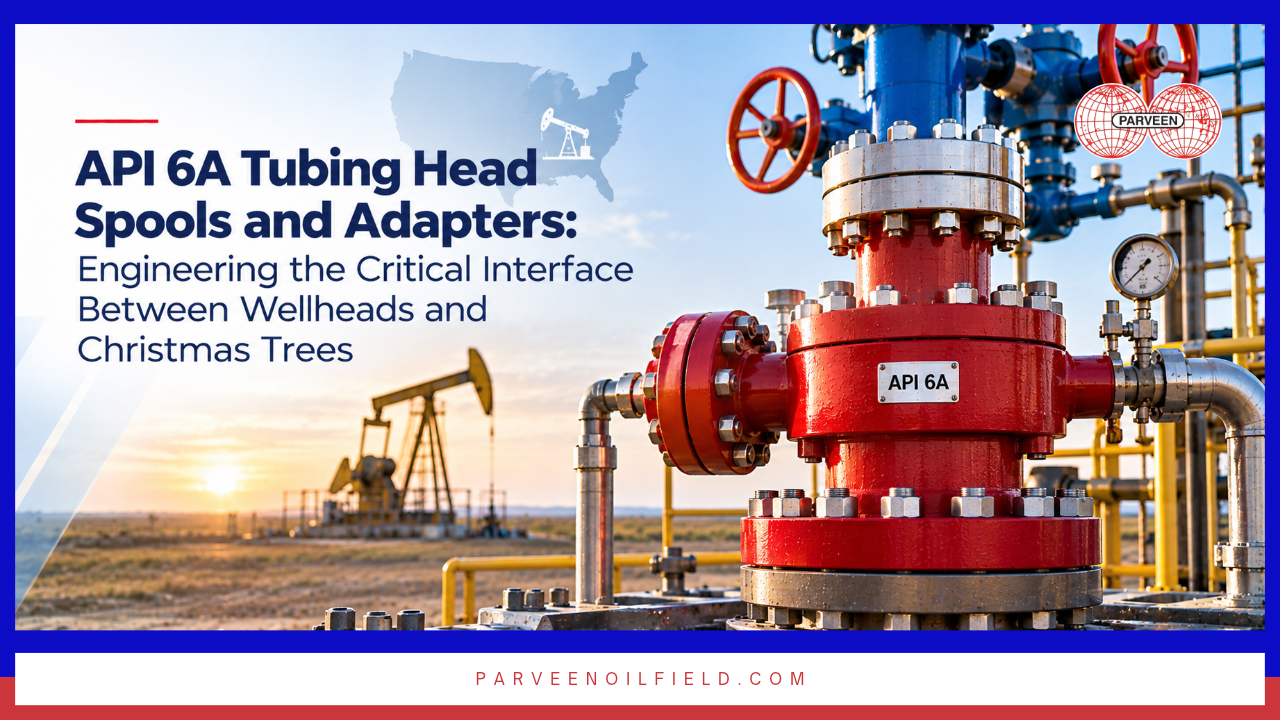
The tubing head spool occupies the top of the casing wellhead stack. Below it sits either the casing head housing or the uppermost casing head spool; above it, the Christmas tree is flanged directly to its top face. This position means the tubing head is simultaneously a casing wellhead component, a hanger body, and a tree interface, three structural and pressure-containing roles that it must fulfill in service simultaneously.
Under API Specification 6A, the tubing head is classified as a wellhead body and is subject to the same pressure class, temperature class, material class, and PSL requirements as casing heads and spools. Working pressure classes relevant to US applications range from 2,000 psi for shallow, low-pressure production in onshore basins to 15,000 psi and above for Permian Basin HPHT wells and Gulf of Mexico deepwater completions.
The defining dimensional feature of a tubing head is its tubing bowl: the internal cavity into which the tubing hanger is landed and locked. The bowl bore diameter matches the OD of the tubing hanger selected for the well’s production tubing size. Standard production tubing ODs in US onshore programmes range from 2-7/8 inch to 4-1/2 inch, with 2-7/8 inch and 3-1/2 inch the most common in Permian Basin horizontal wells. Gulf of Mexico deepwater wells running larger OD tubing may use 5-1/2 inch production strings, requiring a correspondingly larger tubing bowl.
Side outlets on the tubing head, typically 2-1/16 inch or 2-9/16 inch gate valve-fitted connections, provide access to the tubing-casing annulus for pressure monitoring, annular injection, and well control operations. The number and configuration of side outlets varies with the well programme: single outlet for simple onshore wells, dual opposing outlets for wells requiring kill-side access or gas lift injection.
Tubing Head Top Flange and Bore Configuration
The top flange of the tubing head is the mechanical connection point for the Christmas tree. API 6A specifies flange dimensions for standard API bore sizes: 7-1/16 inch, 9 inch, 11 inch, and larger bore sizes at higher pressure classes. The top flange must match the bottom flange of the Christmas tree in both OD, bolt pattern, and ring-groove profile. BX ring gaskets are standard for all wellhead flanges at 2,000 psi and above. The tubing head bore through the top flange must be large enough to pass the production tubing hanger when running in the tubing string, and the bore must also accommodate any wireline or coiled tubing intervention tools specified for the well’s operating programme.
Tubing Hangers: Mechanical Types and Selection for US Wells
The tubing hanger is the device that lands in the tubing head bowl, suspends the production tubing string, and seals the tubing-casing annulus. It is the mechanical heart of the tubing head assembly and its selection is inseparable from the tubing head specification.
Slip-Type Tubing Hangers
Slip-type hangers use segmented slips that are set against the casing or tubing OD inside the tubing bowl to grip and support the string weight. The slips are set either mechanically or hydraulically, and the hanger body also incorporates a primary seal element, commonly an elastomeric packer or metal-to-metal seal, that closes off the annular space between the tubing and the tubing head bore.
Slip-type hangers are common in US onshore programmes where the production tubing string is run after drilling and cementing are completed. They offer installation speed advantages, since the tubing can be run with the hanger pre-installed on the top joint and landed in a single continuous trip. For Permian Basin horizontal wells, where rig time between spud and production on a multi-well pad is a critical efficiency metric, this installation simplicity is valued.
Mandrel-Type Tubing Hangers
Mandrel hangers thread or weld directly onto the top of the production tubing string and land into a machined profile inside the tubing bowl. The hanger itself is a machined body with a landing shoulder that contacts the bowl bowl profile and an integral seal element that energises on landing. For wells requiring positive load transfer independent of friction forces, mandrel hangers provide a more reliable sealing geometry and are the preferred type for sour-service wells and high-load-rating deepwater completions.
For Gulf of Mexico deepwater wells, mandrel tubing hangers are commonly used in conjunction with subsea tubing head spools, where remote landing verification through pressure testing is required rather than visual and mechanical confirmation at a surface rig floor.
SCSSV Control Line Penetrations
For wells with surface-controlled subsurface safety valves (SSSVs), the tubing hanger must incorporate one or more hydraulic control line penetrations: small-bore ports passing through the hanger body from the tubing annulus below to the Christmas tree control ports above. The number and OD of control line penetrations is determined by the number of subsurface valves installed on the tubing string. API 6A specifies the pressure testing requirements for these penetrations, which must be tested separately from the main bore seal.
Tubing Head Adapters: Connecting the Wellhead to the Christmas Tree
The tubing head adapter, sometimes called a spool adapter or tree adapter, is the transitional component between the top of the tubing head and the bottom of the Christmas tree body. While many Christmas trees are flanged directly onto the top of the tubing head with a matching flange, the adapter becomes necessary when the tubing head top flange OD, bore, or pressure class does not match the Christmas tree bottom flange specification.
Adapters are common in several US application scenarios: when upgrading a well from an older-spec wellhead to a new tree design; when the installed tubing head was sized for a larger bore than the tree requires; or when the pressure rating of the original wellhead is being upgraded through a tree change while the casing wellhead remains in place.
API 6A governs tubing head adapter dimensions and pressure class requirements. The adapter must be rated to the working pressure of the higher-rated component it connects, and both flange connections must conform to API 6A ring-groove specifications. Adapters are tested hydrostatically to 1.5 times working pressure in the same manner as any other wellhead body.
For onshore US wells, tubing head adapters are frequently specified during workover operations, where the production Christmas tree is being replaced with a different tree design for enhanced oil recovery (EOR), gas lift, or ESP completion. Having a standard tubing head interface on the existing wellhead and using an adapter to suit the new tree eliminates the need to replace the entire wellhead stack, saving rig time and cost.
Bore, Pressure Class, and PSL Selection for US Well Programmes
For US onshore operators in the Permian Basin, the dominant wellhead pressure class for horizontal, hydraulically fractured wells is 3,000 psi to 5,000 psi at surface, with higher classes specified for HPHT plays in certain sub-basins. For Gulf of Mexico deepwater completions, 10,000 psi and 15,000 psi wellhead equipment is standard, with 20,000 psi increasingly specified as operators target deeper HPHT reservoirs.
PSL selection follows the well’s risk profile. PSL 1 and PSL 2 are common for onshore production wells in standard service. PSL 3 is specified for sour-service wells, offshore wells, and high-pressure onshore programmes where fluid composition, pressure class, or regulatory oversight drives elevated quality requirements. PSL 4 is specified for deepwater and HPHT wells where the consequences of wellhead failure are severe and third-party inspection is mandatory.
US operators often specify wellhead equipment from a single manufacturer or approved vendor list maintained by the operating company. For OEM-distributed wellhead packages, the ability of a manufacturer to supply tubing head spools to a consistent specification with full documentation traceability, including material test reports, hydrostatic test certificates, and dimensional inspection records, is a primary qualification criterion alongside price and lead time.
Parveen Industries’ Wellhead Equipment for US Well Programmes
Parveen Industries manufactures and supplies API-Compliant wellhead and pressure control equipment for US well programmes, covering tubing head spools and wellhead assemblies designed to API Specification 6A.
Single and Dual Completion Wellhead and Christmas Tree Assemblies: Parveen supplies complete wellhead assemblies for single and dual completion configurations, integrating the tubing head spool, tubing hanger, and Christmas tree as a matched set. These assemblies are dimensionally checked for bore and flange compatibility across all connection points before shipment. Single completion assemblies are suited to standard horizontal Permian Basin or Gulf Coast onshore programmes; dual completion configurations are available for two-zone or multilateral wells.
Unitized Well Control Head: For onshore US drilling programmes where rig-up speed and compact wellhead footprint matter, Parveen’s unitized wellhead design consolidates the wellhead stack into a compact body with matched bore transitions, reducing flange connections and streamlining installation. The unitized design is suited to pad drilling operations where rapid rig-to-rig moves are a priority.
Surface Safety Valve: Parveen’s surface safety valve is a hydraulically actuated, fail-safe closed valve designed to API 6A and API 6AV1, suitable for wellhead-mounted emergency shut-in service on US onshore and offshore platform wells. The SSV is compatible with standard wellhead flange sizes and integrates with ESD control systems.
Slab Gate Valve: Tubing head side outlets require gate valves rated to the tubing head’s working pressure. Parveen supplies API 6A slab gate valves in 2-1/16 inch and 2-9/16 inch wellhead outlet sizes at pressure classes from 2,000 psi through 10,000 psi, suitable for tubing-casing annular access service on US production wells.
The full Parveen wellhead product range for US applications is available at the wellhead and Christmas tree category and all products page.
Case Illustration: Tubing Head Replacement During Permian Basin Workover
An operator in the Midland Basin, Texas, has an existing horizontal well completed with a 5,000 psi wellhead stack installed at the time of original completion. The well is being reworked to install a larger-OD production tubing string as part of an artificial lift conversion, requiring a tubing OD change from 2-7/8 inch to 3-1/2 inch. The existing tubing head bowl bore is 2-7/8 inch, too small to accommodate the new tubing hanger.
The workover plan calls for replacing the existing tubing head spool in place, without disturbing the casing head housing or casing head spools below. The new tubing head is specified at 5,000 psi working pressure (matching the installed wellhead class), PSL 2, Material Class DD (non-sour, standard onshore), with a 3-1/2 inch nominal tubing bowl bore to suit the new hanger OD. Side outlets are 2-1/16 inch, matching the existing wellhead gate valves.
The top flange of the new tubing head is a 7-1/16 inch, 5,000 psi API flange to suit the existing Christmas tree’s bottom flange. The installer sets the new tubing head on the existing casing wellhead top flange and tightens with a new BX ring gasket. After hydrostatic testing of the new tubing head in place and confirmation of side outlet gate valve function, the new tubing string is run with the 3-1/2 inch mandrel hanger pre-installed and landed in the new tubing head bowl. A pressure test of the hanger seal confirms tubing-casing annular isolation before the Christmas tree is reinstalled.
The result is a wellhead stack that accommodates the new tubing size without full wellhead replacement, saving the operator the cost and rig time of replacing the casing head housing and spools below.
Frequently Asked Questions
Q1: What is the function of a tubing head spool in a wellhead stack under API 6A?
The tubing head spool serves three simultaneous functions in a wellhead assembly. First, it provides a landing bowl for the tubing hanger, which suspends the production tubing string and seals the tubing-casing annulus. Second, it provides one or more side outlets with gate valves for access to the tubing-casing annulus for pressure monitoring, gas lift injection, or annular kill operations. Third, its top flange provides the structural connection point for the Christmas tree assembly above. API 6A governs all dimensional, material, and testing requirements for tubing head spools as part of the broader wellhead equipment specification.
Q2: When is a tubing head adapter required in a wellhead assembly?
A tubing head adapter is required when the top flange of the installed tubing head does not dimensionally match the bottom flange of the Christmas tree being installed. This situation arises during tree change-outs after workovers, when upgrading from an older-specification wellhead to a new tree design, when the pressure rating or bore of the existing wellhead does not match the new tree’s requirements, or when two components from different wellhead configurations must be interfaced. Adapters must be rated to the working pressure of the higher-rated connected component and must meet the same API 6A material, dimensional, and testing requirements as any other wellhead body.
Q3: How does tubing size affect tubing head spool selection in US Permian Basin wells?
The tubing bowl bore of the tubing head spool must be large enough to pass the tubing hanger OD selected for the specific production tubing size. For Permian Basin horizontal wells typically run with 2-7/8 inch or 3-1/2 inch production tubing, the tubing head bowl bore is specified to match the standard mandrel or slip hanger OD for that tubing size. The top flange bore must also be large enough to pass any intervention tools, coiled tubing assemblies, or completion equipment run through the wellhead after the tree is installed. Specifying a tubing head with a bore that is too small for the planned tubing programme is a common error that requires a wellhead replacement, so specifying bore size against the actual completion design before procurement is essential.
Q4: What pressure class tubing head spool is typically specified for Gulf of Mexico deepwater completions?
Gulf of Mexico deepwater completions typically specify 10,000 psi working pressure wellhead equipment as a minimum, with 15,000 psi increasingly common as operators target high-pressure reservoirs. The choice depends on the anticipated shut-in wellhead pressure (SIWHP), which for deepwater gas wells can exceed 8,000 psi at surface after accounting for reservoir pressure and fluid column hydrostatics. The API 6A pressure class selected must equal or exceed the SIWHP for the well plus any safety margin required by the operator’s well design standard. PSL 3 is typically the minimum for deepwater Gulf of Mexico applications, with PSL 4 specified for HPHT wells.
Q5: What is the difference between a surface safety valve and a tubing head in well control terminology?
The tubing head is a structural wellhead body that lands the tubing hanger and connects to the Christmas tree. It is a passive mechanical component and does not contain an active valve. The surface safety valve (SSV) is an active, hydraulically actuated, fail-safe closed valve typically installed as part of the Christmas tree assembly or on the wellhead flowline immediately downstream of the tree wing valve. The SSV closes automatically on loss of hydraulic control line pressure (ESD signal or control line failure), providing emergency shut-in of the well at surface. These are different components serving different functions and both are governed by API 6A and API 6AV1 respectively.
Q6: Can Parveen supply both the tubing head spool and the Christmas tree as a matched wellhead package for US operators?
Yes. Parveen Industries supplies complete wellhead packages that include the tubing head spool and the Christmas tree assembly as matched components, with all flange connections, bore sizes, and ring-groove profiles dimensionally verified before shipment. This integrated package approach is preferred for US independent operators and OEM distributors who want a single-source supply for the complete surface wellhead assembly. Package configurations are available for single and dual completion wells in pressure classes from 2,000 psi through 15,000 psi. Lead time, PSL specification, and bore configuration options can be discussed with Parveen’s technical sales team.
Source API 6A Tubing Head and Wellhead Components for Your US Well Programme
Whether specifying a fresh wellhead package for a new Permian Basin horizontal well, a replacement tubing head during workover, or a tubing head adapter to suit a tree change-out, the dimensional precision and pressure integrity of the tubing head spool is the standard against which the rest of the surface wellhead stack is calibrated. Specifying API 6A-compliant components with full documentation traceability and matching the bore and flange configuration to the actual tubing programme eliminates the most common wellhead specification errors before they become rig-floor problems.
Parveen Industries is an API-Compliant manufacturer of tubing head spools, wellhead assemblies, gate valves, and surface safety valves, serving US onshore and offshore operators, wellhead distributors, and OEM procurement teams.
Email: info@parveenoilfield.com Website: https://parveenoilfield.com/
Explore the full wellhead and pressure control product range at https://parveenoilfield.com/products/.
Data Sources & References
[1] US crude oil production regularly exceeds 13 million barrels per day. US Energy Information Administration, Petroleum & Other Liquids, October 2026. https://www.eia.gov/petroleum/supply/weekly/
[2] API Specification 6A, Specification for Wellhead and Tree Equipment, 21st Edition. American Petroleum Institute. https://www.api.org/products-and-services/standards/important-standards-and-initiatives/standards-6a
[3] API Specification 6AV1, Specification for Validation Testing of Wellhead Surface Safety Valves and Underwater Safety Valves for Offshore Service. American Petroleum Institute. https://www.api.org
[4] Permian Basin Production Statistics and Completion Data. Texas Railroad Commission, 2026. https://www.rrc.texas.gov/oil-and-gas/
[5] Gulf of Mexico Federal Offshore Oil Production. US Energy Information Administration, 2026. https://www.eia.gov/dnav/pet/pet_crd_crpdn_adc_mbbl_a.htm