
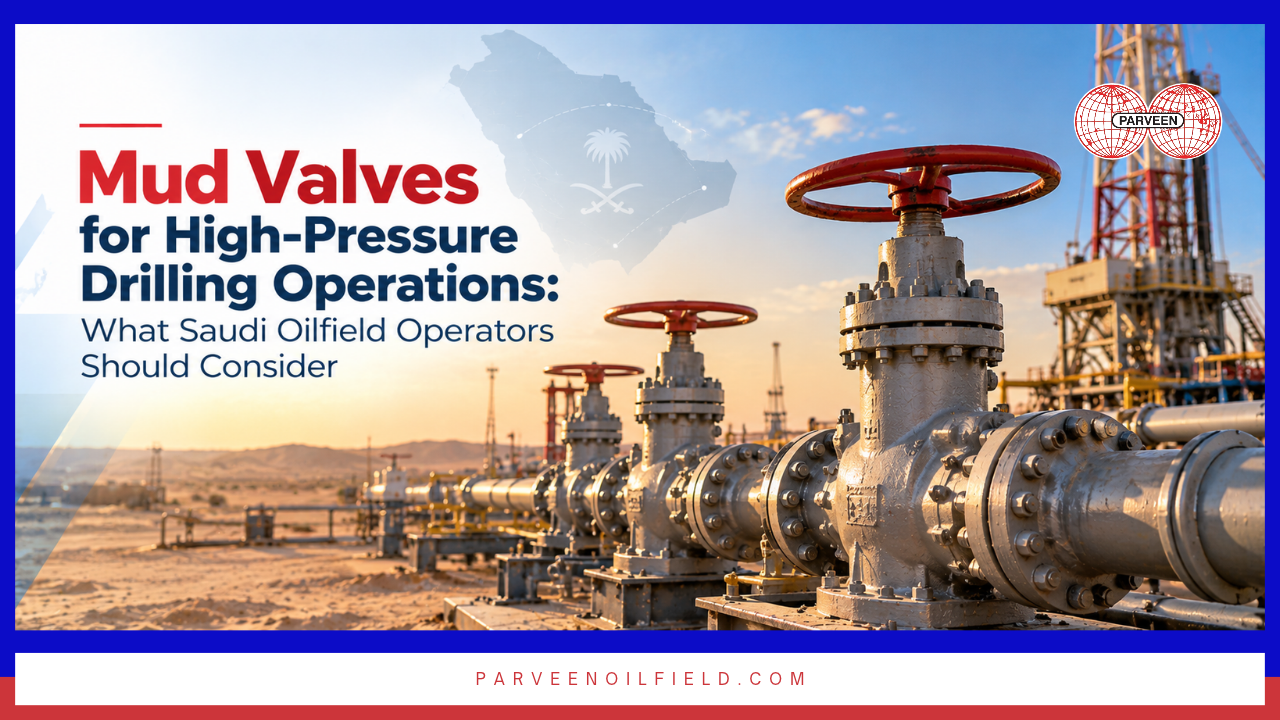
Saudi Arabia remains the world’s most consequential upstream oil and gas market. Saudi Aramco, the world’s largest oil producer by volume, sustained crude oil production of approximately 9.0 to 9.5 million barrels per day (bpd) through 2024 and into 2025, while simultaneously executing one of the industry’s largest capital investment programs to sustain and expand its productive capacity across the prolific onshore and offshore fields of the Eastern Province [1]. Aramco’s Maximum Sustainable Capacity (MSC) program, targeting 12.0 million bpd of crude oil capacity, involves sustained drilling activity across Ghawar, Shaybah, Khurais, Khursaniyah, and other major field complexes, alongside incremental development of the Zuluf, Safaniyah, and Berri offshore fields.
This scale of drilling activity, hundreds of wells per year, drives substantial demand for high-quality drilling equipment across every category of the surface and subsurface well control system. Among the components most exposed to operational wear and most critical to well control safety is the mud valve. A mud valve is an API 6A gate valve specifically designed and constructed to handle the abrasive, erosive, and high-pressure conditions of drilling mud, a mixture of water or oil-based fluid loaded with weighting agents (typically barite), drill solids, and, in aggressive formulations, supplementary chemicals, that is circulated through the drill string and returned via the annulus throughout the drilling process [2].
Unlike production gate valves that handle clean or lightly-contaminated produced fluids, mud valves must maintain reliable sealing and actuation performance against a fluid that is inherently corrosive, abrasive, and capable of building up solid deposits on valve seats and gate faces if not flushed out after use. In Saudi Arabia’s drilling environment, where carbonate and sandstone formations at 8,000–16,000 feet depth require high mud weights to control pore pressures, and where drilling programs are operated on tight time-to-target schedules, valve failures due to erosion, seat damage, or stem packing failure cause costly non-productive time (NPT) and introduce well control risk.
Parveen Industries manufactures API 6A compliant mud valves specifically engineered for the high-pressure, high-erosion conditions of oilfield drilling service. This article examines the engineering considerations that govern mud valve selection for Saudi Arabian drilling operations, the technical features that differentiate a drilling-grade mud valve from a standard gate valve, and how Parveen’s product range addresses the performance demands of KSA-based drilling contractors and operators.
Saudi Arabia’s drilling contractors, including those operating for Aramco under long-term drilling contracts as well as independent service contractors, represent a significant and technically demanding customer base for mud valve procurement. Requirements typically include API 6A Monogram compliance, full material traceability, pressure class and bore size flexibility, and rapid availability to support tight rig mobilisation schedules. Parveen’s manufacturing capability and supply chain infrastructure are positioned to serve these requirements.
Understanding the Mud Valve’s Role in the Drilling System
Where Mud Valves Are Used
Mud valves are installed at multiple points in the surface drilling fluid system. The primary locations include the standpipe manifold, the high-pressure piping arrangement through which drilling mud is pumped from the mud pumps to the swivel and drill string; the choke manifold (where mud valves provide upstream isolation of the choke and kill lines); the mud return line isolation; and the cement and squeeze job piping. In each location, the valve must open and close reliably under the full working pressure of the drilling fluid, and must seal against active mud flow with particles in suspension.
In Saudi Arabia’s drilling environment, standpipe pressures during deep carbonate drilling campaigns commonly reach 3,000–5,000 psi. High-density mud formulations used to control pore pressure in the Khuff gas formation (a prolific gas reservoir in the Eastern Province encountered at depths of 12,000–15,000 feet) require mud weights in excess of 14 ppg (pounds per gallon), generating significant hydrostatic and circulating pressures throughout the standpipe manifold [3]. Mud valves installed in this service must be rated to at least 5,000 psi working pressure (API 6A 5,000 psi class) and must be manufactured from materials capable of withstanding the erosive effect of high-density, weighted mud at elevated temperatures.
Key Performance Requirements for Drilling Mud Valves
The engineering requirements for mud valves in Saudi oilfield service are more demanding than for production gate valves in several respects:
Erosion resistance. Drilling mud, particularly weighted mud with barite and drill cuttings in suspension, is a highly abrasive fluid. The gate and seat faces of a mud valve are directly exposed to this fluid during opening and closing strokes. If gate or seat geometry, material hardness, or surface finish is inadequate, erosion of the sealing surfaces occurs rapidly, resulting in loss of sealing integrity well before the nominal valve service life. API 6A gate valve seats for mud service are typically manufactured from hardened alloy steel (HRC 55–62) or overlaid with tungsten carbide or stellite to resist abrasion.
Pressure-temperature capability. KSA drilling applications require mud valves rated to 5,000 psi or 10,000 psi working pressure, with temperature capability extending to at least 250°F for deep, high-temperature wells. API 6A temperature class PU (−20°F to +180°F) or PX (−20°F to +250°F) applies to most KSA drilling applications.
Flush-bore design. A full-bore (full-opening) gate valve design is preferred for mud service to minimise flow restriction, reduce erosion at the bore transition, and allow pigging or wireline passage where required. Reduced-bore designs that create flow velocity steps, and therefore locally high erosion rates, are generally avoided in standpipe service.
Low-maintenance stem sealing. Stem packing in mud valves must seal against mud that can deposit solids on the stem as it strokes. Valve designs that incorporate grease-injectable stem packings or back-seating arrangements allow stem seal maintenance without depressurising the valve, which is critical for valves in active drilling service where isolation is maintained throughout the drilling operation.
Ease of field maintenance. Drilling contracts in Saudi Arabia operate on demanding NPT targets, any valve failure that requires a major valve disassembly on the rig floor is measured in cost per hour of lost rig time. Mud valves with accessible, replaceable seat and gate assemblies that can be serviced by rig crew with standard tooling, without special workshop equipment, are preferred by Saudi drilling contractors.
Mud Valve Types and Selection Criteria for KSA Drilling
Slab Gate Valves for Mud Service
The slab gate valve, in which a parallel-sided, flat gate element slides between two separate seat rings to open and close the valve, is the predominant valve type for mud standpipe service in Saudi Arabia. The slab gate design provides a flush bore in the open position (no flow obstruction), reliable metal-to-metal seating, and a relatively simple gate/seat interface that can be inspected and serviced in the field.
Parveen manufactures API 6A slab-type gate valves in pressure classes 2,000, 3,000, 5,000, and 10,000 psi and in bore sizes from 2-1/16″ to 7-1/16″, with both API 6B flanged and API 6BX flanged end connections as appropriate for the pressure class. For mud service, Parveen specifies hardened alloy steel seats (minimum HRC 55) and compatible gate material to ensure the gate-to-seat contact is resistant to abrasion from weighted drilling fluid. Parveen’s slab and expanding gate valves are available with manual (handwheel) or hydraulic actuator options.
Expanding Gate Valves for High-Pressure Mud Service
For high-pressure applications, particularly 10,000 psi and above, or where the valve must provide a bi-directional, metal-to-metal tight seal against both flow directions, the expanding gate valve offers advantages over the slab gate design. In an expanding gate, the gate element consists of two segments that expand radially outward under actuation force to contact both the upstream and downstream seat faces simultaneously. This design provides a positive, self-energised seal that is independent of fluid pressure direction and is particularly effective in service where pressure direction may reverse (as can occur in kill line service during a well control event).
In Saudi Arabia, expanding gate valves are specified for choke manifold isolation valves, kill line valves, and BOP stack drilling spool valves where the ability to isolate under full wellbore pressure from either direction is a functional requirement. Parveen’s slab and expanding gate valve range covers both slab and expanding configurations across the full API 6A pressure class range.
Manual vs. Hydraulic Actuation
Manual mud valves, operated by a handwheel through a stem-and-bonnet assembly, are the standard configuration for standpipe manifold isolation service in Saudi Arabia, where the drilling crew can access and operate the valve directly. For remote or automated actuation, such as choke manifold valves operated from the driller’s console during a well control event, hydraulic actuators are specified. Parveen manufactures both manual and hydraulic actuation configurations for all mud valve types, with hydraulic actuators conforming to API 6A and appropriate actuator standards.
Parveen Industries’ Mud Valve Portfolio for Saudi Arabia
Parveen Industries’ gate valve product range encompasses all mud valve types required for high-pressure drilling service in Saudi Arabia:
Mud Valve (API 6A): Parveen’s purpose-built mud valves are API 6A compliant gate valves with hardened seats and gates specifically designed for abrasive mud service. Available in 2,000, 3,000, 5,000, and 10,000 psi rated working pressure. Full-bore (full-opening) design. Bore sizes from 2-1/16″ to 4-1/16″. 6B flanged end connections standard; 6BX available for 10,000 psi and above. API temperature class PU through PX. Manual actuation standard; hydraulic actuation available on request. Supplied with API 6A Monogram compliance documentation, material test reports, dimensional inspection records, and pressure test certificates.
Slab and Expanding Gate Valve (API 6A): Full range of slab gate and expanding gate valves for wellhead, choke manifold, and high-pressure drilling system applications. Pressure classes 2,000–15,000 psi. Material classes AA through HH for sweet and sour service. End connections: 6B and 6BX flanged, or API 6A threaded as specified.
Manual Gate Valve: Standard-service manual gate valves for drilling fluid isolation applications at lower working pressures. Available in a range of bore sizes and pressure classes for auxiliary drilling system manifolding.
Hydraulic / Slab Type Gate Valve: Hydraulically actuated slab gate valve for remote operation from BHA or driller’s console. Suitable for choke manifold main isolation service and automated well control system integration.
Choke and Kill Manifold: API 16C compliant choke and kill manifolds incorporating multiple mud valves and adjustable choke valves in a pre-assembled skid or modular configuration. Rated working pressures 5,000–15,000 psi. The choke and kill manifold integrates directly with the BOP stack flanged outlets and provides the surface well control system for all Saudi Arabia drilling operations.
Wellhead & Christmas Tree Assemblies: API 6A compliant wellhead assemblies incorporating production gate valves and flow control components for the transition from drilling phase to production phase.
Adjustable Choke Valve: Adjustable choke valves for the choke manifold assembly, providing variable back-pressure control during well kill operations and flow testing in Saudi Arabia’s drilling campaign workflows.
Case Illustration: Mud Valve Performance in Saudi Aramco Carbonate Drilling
Consider a Saudi Aramco drilling campaign in the Ghawar field, targeting an Arab-D reservoir interval at approximately 7,500 feet TVD. The well programme calls for a weighted water-based mud (WBM) at a mud weight of 12.5 ppg through the 8-1/2″ hole section, with standpipe circulating pressure reaching 3,200 psi at maximum flow rate. The choke and kill manifold is rated to 5,000 psi RWP, conforming to API 16C.
The standpipe manifold is configured with two 3,000 psi-rated mud valves (5-1/8″ bore, API 6B flanged, manual actuation) for main standpipe isolation, and the choke manifold incorporates four 5,000 psi-rated mud valves with hydraulic actuation for remote operation from the driller’s console. All mud valves are manufactured to API 6A with hardened seat and gate surfaces (HRC 58+) to resist erosion from the barite-weighted mud.
During a minor influx event at 7,200 feet, the driller activates the BOP stack and shuts in the well. The choke manifold mud valves are used to circulate out the influx using the drillers’ method, with the hydraulically actuated choke manifold valves allowing precise pressure management from the driller’s console without crew having to approach the manifold physically. After the influx is circulated out and the well is returned to drilling, the mud valve seats and gate faces are flushed with water prior to leaving the valves in the open position for continued drilling, a standard maintenance practice that prevents solid deposits forming on the sealing surfaces during extended open service.
This scenario illustrates the operational reliability that properly specified and maintained API 6A mud valves provide in the demanding drilling environment of Saudi Arabia’s major field development campaigns.
Frequently Asked Questions
Q1: What API specification covers mud valves, and what does API 6A compliance mean for a Saudi operator’s mud valve procurement?
Mud valves for oilfield drilling service are covered by API Specification 6A (Specification for Wellhead and Tree Equipment, 21st Edition), which defines dimensional requirements, pressure classes, material requirements, and testing protocols for gate valves used in the wellhead and drilling system. API 6A compliance, specifically, holding the API Monogram for gate valve manufacture, means the manufacturer has been audited and approved by the American Petroleum Institute to confirm that its quality management system, manufacturing processes, and testing capabilities conform to API 6A requirements. For Saudi operators and drilling contractors supplying Aramco, API 6A Monogram compliance is a standard procurement requirement.
Q2: What mud weight and mud types can Parveen’s mud valves handle?
Parveen’s API 6A mud valves are designed for the full range of drilling fluid types used in Saudi oilfield service: water-based mud (WBM) with barite weighting agents, oil-based mud (OBM), and synthetic-based mud (SBM). The hardened gate and seat materials are rated for continuous service with mud weights up to 20 ppg, covering the heaviest mud formulations used in high-pressure deep drilling in the Rub’ al Khali and Hadriya formations. For OBM service at elevated temperatures, Parveen specifies compatible elastomeric stem seal materials (FKM or HNBR) in place of the standard NBR packing to ensure seal integrity.
Q3: What is the typical service life of a mud valve in Saudi Arabia’s standpipe manifold service?
Under normal drilling conditions with appropriate maintenance, including post-job flushing to remove abrasive solids from the gate/seat interface and periodic stem packing greasing, Parveen’s mud valves are designed for a service life of 2–3 years in active standpipe manifold service, equivalent to 20–30 drilling well campaigns on a Saudi onshore drilling rig operating on typical well cycle times. Choke manifold valves, which see more frequent actuation and potentially higher erosive service during kick circulation, may require seat replacement or complete valve rebuild every 12–18 months under intensive use. Parveen provides spare parts (seat sets, gate assemblies, stem seal kits) for all mud valve models.
Q4: Can Parveen supply mud valves that meet Saudi Aramco’s material and documentation requirements?
Yes. Parveen has experience supplying to the documentation and material traceability standards typical of Saudi Aramco and major KSA drilling contractors. Standard supply documentation includes: API 6A Monogram compliance declaration, material test reports (MTRs) from approved mills, dimensional inspection report per API 6A Table 1, hydrostatic body pressure test certificate (1.5× RWP), seat/seal test certificate (RWP), and visual inspection report. Additional documentation, including third-party inspection (TPI) by client-nominated inspection agencies, NACE MR0175 compliance declarations, positive material identification (PMI) records, and CoC from certifying authority, is available on request.
Q5: What bore sizes and pressure classes does Parveen offer for mud valve applications in KSA?
Parveen offers mud valves in the following standard configurations for KSA drilling service: bore sizes 2-1/16″, 2-9/16″, 3-1/8″, 4-1/16″, and 5-1/8″; rated working pressures 2,000, 3,000, 5,000, and 10,000 psi; end connections 6B flanged (up to 5,000 psi) and 6BX flanged (10,000 psi and above); material class AA (carbon steel, sweet service) and DD/EE (stainless and alloy steel for sour or corrosive service). Non-standard bore sizes and pressure classes can be manufactured to client specifications subject to dimensional feasibility review.
Q6: What is the typical lead time for mud valve supply to Saudi Arabia, and does Parveen stock mud valves for urgent requirements?
Standard mud valve configurations in common bore sizes (2-1/16″ to 4-1/16″) and pressure classes (3,000 psi and 5,000 psi) are typically held in stock or can be manufactured within 4–8 weeks from confirmed purchase order, depending on stock availability at the time of order. Complete choke and kill manifolds incorporating multiple mud valves require 10–16 weeks from approved drawings to despatch. For urgent KSA requirements, Parveen’s sales team can check current stock availability and advise on the fastest available delivery option. Airfreight to Dammam or Riyadh is available for urgent single-item requirements. KSA buyers can contact Parveen’s Delhi or Mumbai offices, both of which maintain international export capability.
Specify Mud Valves for Your Saudi Drilling Operations
KSA-based drilling contractors, operators, and procurement teams sourcing API-compliant mud valves and complete choke and kill manifold packages for Saudi Arabia drilling campaigns are invited to contact Parveen Industries. Parveen’s technical and commercial team can review well data, confirm pressure class and bore size requirements, and provide complete product and documentation information.
📧 Contact Parveen Industries, KSA / Global Website: parveenoilfield.com Email: info@parveen.in
Explore the full gate valve and drilling equipment range at parveenoilfield.com/gate-valves-choke-manifolds-wellheads-x-mas-trees/ or view all products at parveenoilfield.com/products/.
Data Sources & References
[1] Saudi Aramco Production and Capacity Data, Saudi Aramco Annual Report 2024 / 2025 Interim Updates. Production volumes, MSC targets, and capital investment program. https://www.saudiaramco.com/en/investors/annual-report
[2] API Specification 6A, 21st Edition, Specification for Wellhead and Tree Equipment. American Petroleum Institute. Governing standard for mud valves and gate valves in drilling service. https://www.api.org/
[3] Khuff Formation Drilling Parameters, Saudi Arabia Upstream Geology. Eastern Province carbonate reservoir depths, pore pressures, and drilling fluid weight requirements. S&P Global Commodity Insights / trade.gov Saudi Arabia Oil & Gas Guide. https://www.trade.gov/country-commercial-guides/saudi-arabia-oil-gas-petrochemicals
[4] Mud Valves and Gate Valves for Oilfield Drilling, Technical Product Reference. F-E-T (Forum Energy Technologies). https://f-e-t.com/drilling/drill-fluid-handling/mud-gate-valves/