
The Two-Phase Equipment Challenge in Shale Completions
U.S. shale wells are unique in requiring surface well control equipment to perform reliably across two distinctly different operational phases — each with its own pressure profile, flow characteristics, and equipment demands — within the same producing life of the well.
During the completion phase, the wellhead must support hydraulic fracturing operations at treating pressures routinely reaching 10,000–15,000 PSI, with high-rate abrasive slurry flowing through a frac tree that must cycle open and close repeatedly across dozens or hundreds of frac stages. During the production phase, the same wellhead must support a production Christmas tree that manages declining reservoir pressure over twenty or more years, with gate valves that must remain serviceable decade after decade.
The oil well Christmas tree market reflects the value the industry places on these assemblies. Valued at USD 4.5 billion in 2025 and projected to reach USD 7.2 billion by 2033 at a CAGR of 6.5% [1], the market is being driven by the increasing complexity of completions, longer laterals, and the growing recognition that tree specification — not just frac job design — determines long-term shale well performance. For U.S. shale operators, selecting the right wellhead and Christmas tree is a decision with implications across the well’s full productive life.
This guide walks shale operators, EPCs, and procurement teams through the selection framework for wellhead systems and Christmas trees in U.S. unconventional operations.
Understanding the Wellhead’s Role Across the Shale Well Lifecycle
The wellhead is present and active from spud to abandonment — it supports the BOP during drilling, the frac tree during completion, and the production tree throughout production [2]. Understanding what it must do at each stage is the foundation of correct specification.
During Drilling: The wellhead’s primary function is to support the BOP stack and provide sealed conduit access to the wellbore for drilling fluid circulation. The wellhead lands and seals the surface and production casing strings, and its lateral outlets are used for BOP connection. At this stage, the wellhead’s dimensional accuracy and hanger sealing integrity determine whether casing pressures are properly contained during drilling — particularly during kick events in Permian Basin wells where high-pressure gas zones can be encountered at varying depths across pad locations.
During Hydraulic Fracturing: The frac tree is landed on the wellhead in place of the production tree. The frac tree must accommodate high-rate slurry injection at 10,000–15,000 PSI WP, with high-velocity sand-laden fluid flowing through large-bore connections to the treating manifold. The wellhead must withstand this pressure and flow profile without extrusion of hanger seals or body distortion — which means the wellhead’s structural design, not just its pressure rating, matters. Heavy-duty reinforced frac tree designs rated to 10,000–15,000 PSI or higher, with large-bore goat heads or zipper manifold connections at the top, are the standard approach in Permian, Eagle Ford, and Bakken pad completions [2].
During Production: Once fracturing is complete, the frac tree is removed and a production Christmas tree is landed on the wellhead. The production tree provides the long-term flow control, pressure management, and well access functions. A production tree’s five valves — lower master valve, upper master valve, wing valve, kill wing valve, and swab valve — each serve a distinct isolation and control function. Dual master valves (lower and upper) are standard in many U.S. regulatory contexts where dual barriers for primary pressure containment are required [2].
The Frac Tree to Production Tree Transition: Getting It Right
The transition from frac tree to production tree is a critical operational step in shale completions that is frequently underplanned from an equipment specification perspective. Several factors must be addressed at the wellhead selection stage — not at the time of transition — to ensure the changeover is smooth:
Wellhead-to-Tree Interface Standardisation: The flange interface between the top of the tubing head and the bottom of the Christmas tree must be common between the frac tree and the production tree. If the frac tree uses a different flange specification at this interface than the production tree, a separate adapter spool is required — adding time, cost, and an additional potential leak point to the changeover. For pad drilling programs where the same wellhead configuration is repeated across ten or twenty wells, standardising the wellhead-to-tree interface across both frac and production trees from the start eliminates this problem entirely.
Wellhead Bore Compatibility: The production tubing string is typically set after fracturing is complete, through the existing wellhead bore. The wellhead’s tubing hanger bowl must accommodate the production tubing hanger at the planned tubing OD and connection — confirmed from the completion engineering program, not assumed from a catalogue bore size.
Working Pressure Class Continuity: The production tree must be rated to the same working pressure class as the wellhead it lands on. A 15,000 PSI WP wellhead paired with a 5,000 PSI WP production tree is a 5,000 PSI WP system — the weakest component defines the system rating. For Permian Basin wells where wellhead pressures during the first years of production can approach 3,000–5,000 PSI and may occasionally exceed that range during restimulation or build-up periods, the production tree pressure class must account for the full anticipated pressure envelope, not just the expected normal flowing pressure.
Selecting the Production Christmas Tree for Long-Life Shale Service
The production Christmas tree specification for a shale well involves several interdependent decisions:
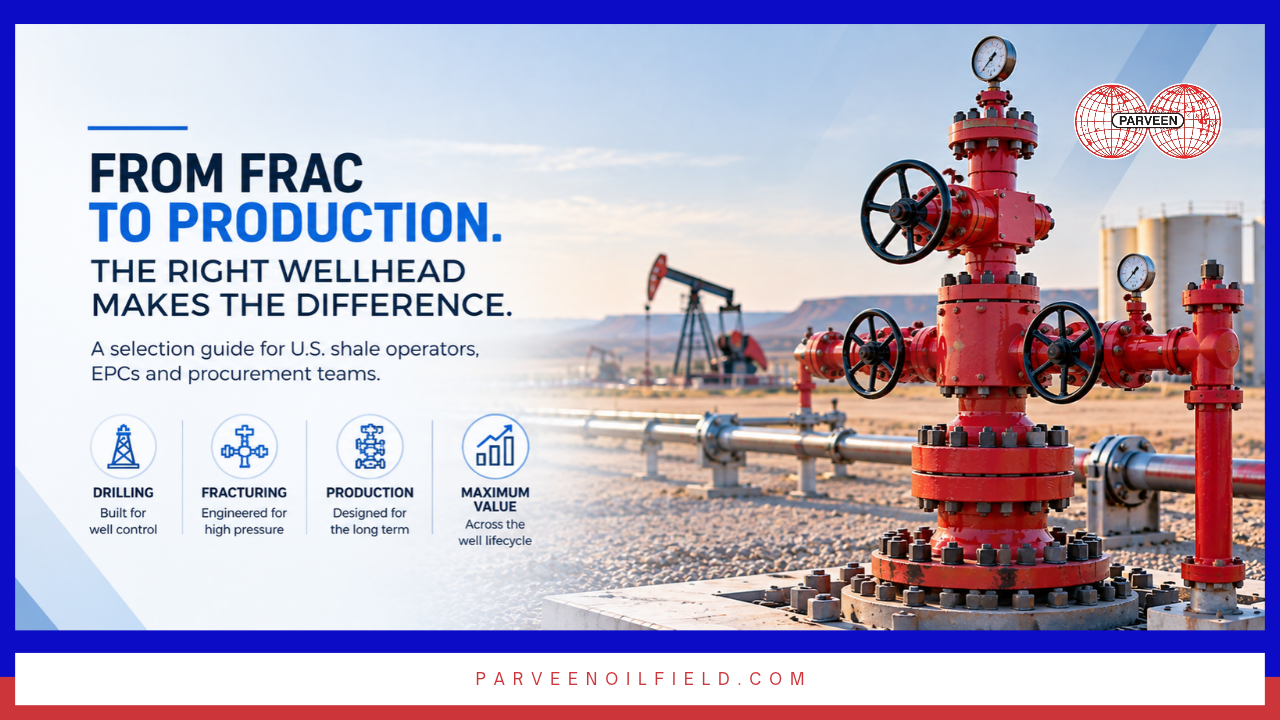 Gate Valve Configuration: Standard U.S. shale production trees include five main valves: lower and upper master valves (vertically stacked above the wellhead), production wing valve (lateral outlet to flowline), kill wing valve (lateral outlet for pressure control and well service access), and swab valve (top access valve for wireline and coil tubing operations). For high-rate Permian wells where the lower master valve sees sustained high differential pressure and high-rate through-flow, Parveen’s slab and expanding gate valves with sealant injection provisions provide the extended service life that a 20-year shale production program demands.
Pressure Rating: Standard Christmas tree pressure classes for U.S. shale production are 5,000 PSI WP for lower-pressure shale wells (typical Eagle Ford and Haynesville gas wells with moderate wellhead pressure), 10,000 PSI WP for the majority of Permian Basin and high-pressure shale applications, and 15,000 PSI WP for the highest-pressure Permian wells or wells with anticipated shut-in wellhead pressures exceeding 7,500 PSI. Select the tree pressure class from the maximum anticipated shut-in wellhead pressure, with a minimum 25% safety margin above the calculated value.
Bore Size: Full-bore trees — where the through-bore of all tree valves equals the production tubing ID — are specified for high-rate producers where any restriction in the production string represents a measurable production penalty. Reduced-bore trees, with valve bores smaller than the tubing ID, are used where production rates are modest and the cost differential is material. For shale wells producing above 500 bpd of liquid, full-bore trees should be the default specification.
Wellhead System Integration: Parveen supplies complete wellhead and xmas tree assemblies for U.S. shale — covering casing head spools, tubing head spools, tubing head adapters, and production Christmas trees in a dimensionally integrated package. Unitised wellheads are available for programs prioritising installation speed and elimination of field-assembled flanged connections.
Pad Drilling Repeatability: For multi-well pad programs, standardising wellhead and tree configurations across all wells on the pad — and across multiple pads in the same basin development program — dramatically reduces procurement complexity, simplifies spare parts management, and allows wellhead installation crews to build efficiency through repeated identical installation sequences. Parveen can supply pre-manufactured, pre-tested wellhead and tree packages in standardised configurations for pad drilling programs, with staged delivery aligned to the rig schedule.
Integrating the Frac Tree with Wellhead and Completion Systems
The frac tree is temporary equipment — it is installed for the completion phase and removed before the production tree is landed. But it must be fully integrated with the permanent wellhead and completion systems:
The frac tree’s lower connection must match the wellhead’s top flange configuration — typically a flanged or studded API 6A connection at the rated working pressure of the wellhead. For wellheads rated to 10,000 PSI WP, the frac tree must also be rated to 10,000 PSI WP minimum at the wellhead interface.
Parveen’s plug valves — the high-frequency cycling valve of choice for frac tree service — provide the quarter-turn metal-to-metal isolation and sealant injection capability required during multi-well pad frac operations. Choke and kill manifolds connected to the wellhead’s kill wing outlet provide pressure management and well control access during fracturing. Surface safety valves on the production tree’s wing valve position provide automated shut-in capability for remotely monitored shale production wells.
Frequently Asked Questions (FAQs)
Q1. What is the difference between a frac tree and a production Christmas tree, and do I need both? A frac tree is heavy-duty temporary equipment designed specifically for hydraulic fracturing operations — rated to 10,000–15,000 PSI WP with reinforced bodies, abrasion-resistant trim, and large-bore connections for high-rate slurry injection [2]. It is installed on the wellhead during the completion phase and removed once fracturing is complete. A production Christmas tree is permanent equipment installed for the well’s producing life — it provides long-term flow control, well access, and pressure management. Most shale completions use both: a frac tree during completion, replaced by a production tree for the producing life. Some operators use completion trees designed to serve both functions, reducing the changeover step.
Q2. Can I use the same wellhead for both the frac and production phases? Yes — and this is the standard approach in U.S. shale. The wellhead (casing heads, tubing head spool, and associated gate valves) is a permanent installation that supports both the temporary frac tree during completion and the permanent production tree during production. What changes is the tree assembly landed on top of the wellhead. The wellhead’s pressure rating must accommodate both the frac phase (potentially 15,000 PSI) and the production phase (potentially 5,000–10,000 PSI) — so the higher of the two phases governs the wellhead pressure class specification.
Q3. What pressure class wellhead and tree do I need for a Permian Basin horizontal well? The Permian Basin’s Delaware and Midland sub-basins span a wide range of wellhead pressures. For most Permian producers, 10,000 PSI WP wellhead and Christmas tree equipment provides adequate margin. For high-pressure Delaware Basin wells — particularly deeper targets where shut-in wellhead pressures can approach or exceed 7,500 PSI — 15,000 PSI WP equipment is appropriate. The correct specification is determined from the well’s maximum anticipated shut-in wellhead pressure calculation, with a minimum 25% safety margin above that value. Parveen recommends confirming the pressure class with the operator’s drilling engineering team before purchase order placement.
Q4. How does pad drilling repeatability affect wellhead and tree specification decisions? Pad drilling — where a rig drills multiple wells from a single surface location — creates an opportunity to standardise wellhead configurations across all wells on the pad and across multiple pads in the same basin campaign. Standardisation reduces procurement lead times (standardised parts can be held in pre-manufactured inventory), simplifies installation (the same crew installs identical equipment on every well), and reduces spare parts complexity. For operators with multi-well annual completion programs, Parveen recommends early engagement to establish a standardised wellhead and tree specification that is locked across the campaign — eliminating repeated specification exercises for each well.
Q5. What gate valve features are most important for long-life U.S. shale production tree service? For shale production trees with a 20-year service life, the most important gate valve features are: sealant injection provisions (allowing in-situ seal restoration without valve removal when seat erosion begins); metal-to-metal secondary sealing surfaces (providing a backup pressure barrier when primary elastomeric seals degrade after years of service); and sealant-compatible body materials (allowing repeated sealant injection events without body contamination that reduces injection effectiveness). Parveen’s slab and expanding gate valves incorporate all three features as standard for U.S. shale production service.
Q6. Can Parveen supply complete wellhead and Christmas tree packages for U.S. shale pad programs, including pre-tested assemblies? Yes. Parveen supplies pre-assembled, factory-pressure-tested wellhead and Christmas tree packages for U.S. shale pad programs. Factory assembly eliminates on-location make-up of flanged connections and the leak-risk associated with field-assembled joint quality variation. Pre-tested packages arrive with a complete hydrostatic test certificate and dimensional inspection record, reducing the incoming inspection burden on the operator’s completion team. Staged delivery aligned to the rig schedule is available for multi-well pad programs.
Call to Action
In U.S. shale, the wellhead and Christmas tree must perform across two phases and twenty years. Specifying them correctly from the start — with the right pressure class, the right frac-to-production tree interface, and the right pad drilling repeatability design — is the decision that keeps intervention costs out of your long-range budget.
Contact Parveen Industries to discuss wellhead and Christmas tree specifications for your U.S. shale pad program.
📧 Visit parveenoilfield.com to submit your well program or request a technical consultation.
Parveen Industries — API-Compliant. Shale-Specified. Lifecycle-Ready.
Data Sources & References
[1] The oil well Christmas tree market valuation of USD 4.5 billion in 2025 projected to reach USD 7.2 billion by 2033 at a CAGR of 6.5% from 2026 to 2033, driven by increasing completion complexity, longer laterals, and demand for intelligent systems, is from Verified Market Reports’ Oil Well Christmas Tree Market report, published April 2026 (https://www.verifiedmarketreports.com/product/oil-well-christmas-tree-market/).
[2] The wellhead’s role across all phases — supporting the BOP during drilling, the frac tree during completion, and the production Christmas tree post-completion — is described by CDI Products’ technical article on wellhead vs Christmas tree differences (https://www.cdiproducts.com/blog/wellhead-christmas-tree) and by CRC Wellhead’s complete guide to Christmas tree production assemblies, published June 2026 (https://crcwellhead.com/what-is-a-christmas-tree-in-oil-and-gas-a-complete-guide-to-production-assemblies/). The description of frac trees as heavy-duty equipment typically rated 10,000–15,000 PSI with reinforced bodies, abrasion-resistant trim, and goat heads for multi-stage frac connections, and the dual master valve architecture required in many U.S. regulatory contexts, are from the same CRC Wellhead source.